


Within the ranks of the global feminist movement, art has played an important part in structuring and developing a critical discourse which has shattered the fundamental inequalities between women and men. Initially focused on claims for judicial regulation and political rights for white, heterosexual women, the feminist discourse – or to put it more accurately, some radical feminist positions – also focuses on sexual and gender minorities. The need to question the state-endorsed heteronormativity joined forces with the freedom from the patriarchal logic and sexism: “Until all of us are free, all of us are prisoners” is the premise for…


By Veda Popovici Gentrification is defined as the dislocation of low-income populations from urban areas through economic and social pressures exercised by a privileged class looking for new (real-estate) markets to create surplus value. Therefore, it represents the new boundary of conflict between social classes, a boundary which is important to reveal in order to understand the mechanisms of contemporary capitalism. Like any political phenomenon, gentrification has a specific geography. Launched in the centers of Western modernity, it was propagated together with the capitalist colonization and urbanization of other geographic areas. In Eastern Europe, gentrification comes alongside the import of…
by Stefan Voicu In debates on art and gentrification, one often encounters the assumption that the mere presence of artists and art in an urban area with real estate potential automatically impacts the market price of a building and/or of the land on which it is situated. In fact, such a causality is reductionist and more often than not, random. Moreover, it is seldom a strategy of real-estate investors. In Romania – Bucharest in particular, since it is the area I’m most familiar with – the more or less legal connections between investors and public officials do not require such…
by Sharon Zukin[1] Providing space in the city for artists is more complicated than it appears. Although the idea originates in philanthropy- as a payment or a subsidy in kind rather than in money- it often has the effect of enhancing property values, and so it becomes a springboard for real estate development. This phenomenon is not peculiar to New York. By the mid-sixties, even local elites in Sun Belt cities, notably Dallas and Los Angeles, planned to redevelop their downtown around an arts presence. The early-twentieth century “civic centers,” which were planned and built by earlier local elites, suggest…
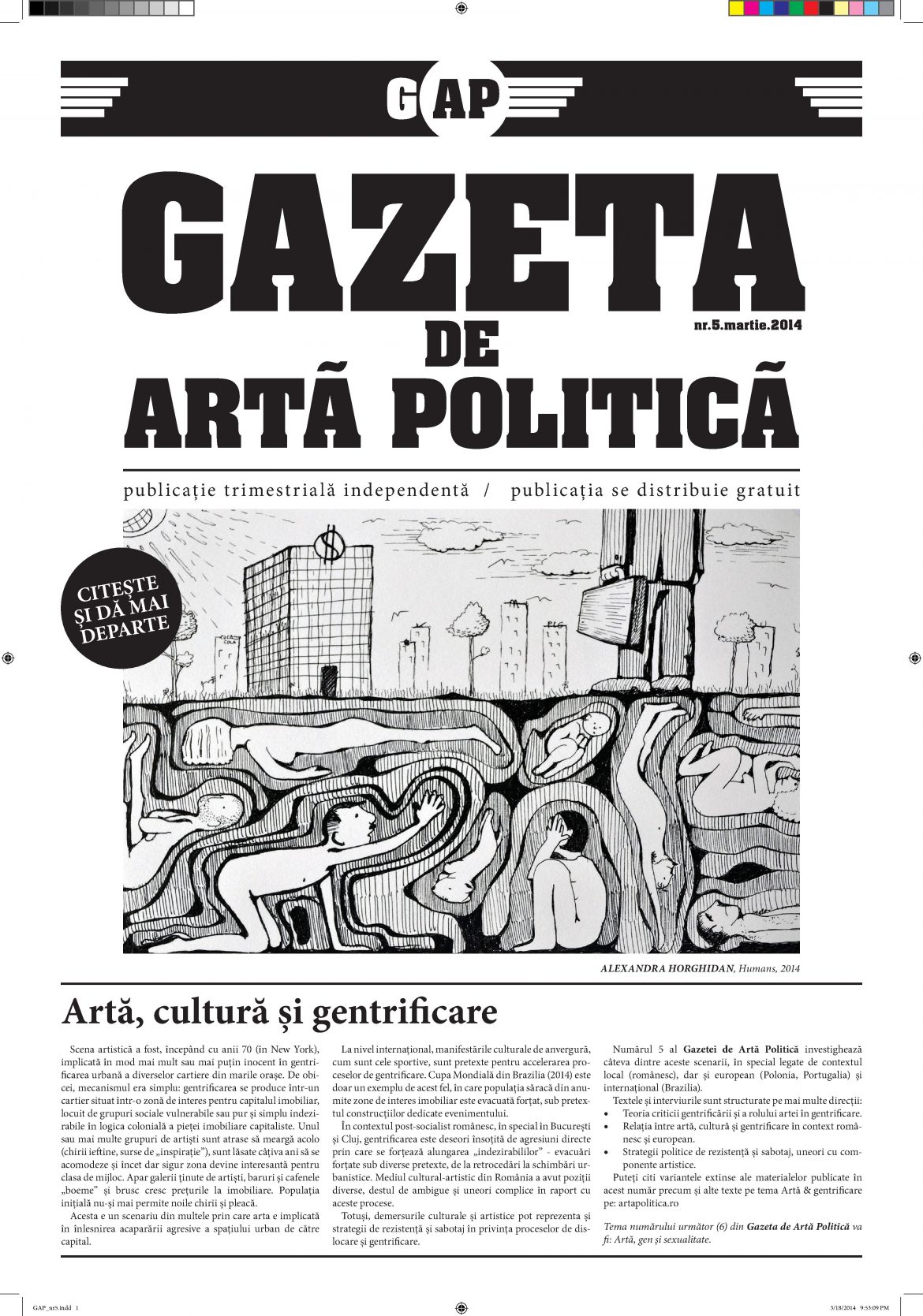
*Tema GAP 5 Scena artistică a fost, începând cu anii 70 (în New York), implicată în mod mai mult sau mai puțin inocent în gentrificarea urbană a diverselor cartiere din marile orașe. De obicei, mecanismul era simplu: gentrificarea se produce într-un cartier situat într-o zonă de interes pentru capitalul imobiliar, locuit de grupuri sociale vulnerabile sau pur și simplu indezirabile în logica colonială a pieței imobiliare capitaliste. Unul sau mai multe grupuri de artiști sunt atrase să meargă acolo (chirii ieftine, surse de “inspirație”), sunt lăsate câțiva ani să se acomodeze și încet, dar sigur, zona devine interesantă pentru clasa…


by Ioana Pelehatăi I’m a child of the 90s, my Sex Ed consisting of sneak peeks into Bravo magazine, because it was “shameful.” I don’t really know how, but I was struck by a bolt of feminism. I first came across The Vagina Monologues – a text already famous in the US at that time – when I was 17 or 18, on the long since decommissioned station Acasă. Back then, TV still had the occasional outburst of life. Or maybe the HBO documentary based on the performance was pseudo-feminist enough and cheesy enough to enthrall both housewives and teenage…