


by Stefan Voicu
In debates on art and gentrification, one often encounters the assumption that the mere presence of artists and art in an urban area with real estate potential automatically impacts the market price of a building and/or of the land on which it is situated. In fact, such a causality is reductionist and more often than not, random. Moreover, it is seldom a strategy of real-estate investors. In Romania – Bucharest in particular, since it is the area I’m most familiar with – the more or less legal connections between investors and public officials do not require such a strategy.
A discussion about art and gentrification in Romania would be a somewhat speculative one and, in case it does take place, it should focus on the hierarchies in the creative industry and the contribution of cultural workers to the organization of post-Fordist labor. The latter produce creative workspaces in urban areas with real-estate potential, thus contributing to the removal of “indigenous” communities and to the arrival of service workers in downtown areas of the city. Cultural workers are the accidental mediators of change, but when the gentrification process starts unfolding, they have to make a choice and take sides.
The main work on the topic is Loft Living. Culture and Capital in Urban Change, published by Sharon Zukin in 1982.[1] Her argument revolves around industrial warehouses in New York which appeared on the real-estate market and were turned into housing for the middle class, discussing the role played by art and artists in the process. Although Zukin talks about a significant change in the global political economy and adjacent transformations in the organization of capitalist production, her arguments have been often reduced to a simple formula: artistic activity + derelict industrial area = gentrification. O closer reading reveals the emphasis placed by Zukin on the expansion and transformation of the middle class and of the lifestyle and labor of the new petty bourgeoisie. Gentrification through art would not have happened without these transformations.
In Bucharest, the gentrification process has a special dynamic due to the city’s position in the global political economy. In 2000, Liviu Chelcea published a study on the gentrification of an area in downtown Bucharest wherein he argued that “special emphasis must be placed on the role and transformations of property rights.”[2] In his study, he described this as a process of primitive accumulation, meaning a way to obtain a profit with little or no investment. Chelcea described this accumulation in the following terms:
“[…] a dynamic group of real-estate agents and private individuals appropriate the difference between the market value of centrally located property and the value for which they were sold or allocated by the state. They aim to influence the municipality and former tenants turned owners, especially the poor ones, to sell them such properties – and they are very persistent. These informal, non-procedural transfers of property rights are part and parcel of the reconfiguration of the class system and of the new accumulation of wealth.”[3]
The similarities between the gentrification described by Zukin and that described by Chelcea reside in the transformations of the structure of social classes. However, if between 1960 and 1990, New York’s middle class was expanding through the embourgeoisement of artists who were becoming role models of labor in the reskilling of the upper classes during deindustrialization, between 1990 and 2000 Bucharest was hit by a forced neoliberalization of the economy. This process did not produce a middle class in the vein of artistic labor, but rather a middle class rooted in the old model of the merchant.
This does not mean one cannot notice the emergence of a creative class in post-Socialist Romania. However, this class does not adopt the work-model of the local artist, but rather that of the Western middle class. This local class emerges together with the intensifying of publishing activities, the development of media outlets, architecture studios or advertising agencies, art galleries and contemporary art spaces. These creative spaces came to meet the propaganda needs of the new market economy and implicitly of the “culturalization” of the working classes, as well as the reskilling needs of the former upper class. By culturalization I mean the reliance of the new economy on the accumulation of capital from the production, exchange and consumption of culture; therefore, workers have to be taught how to operate with cultural means of production and they have to want to consume cultural commodities.
[…]
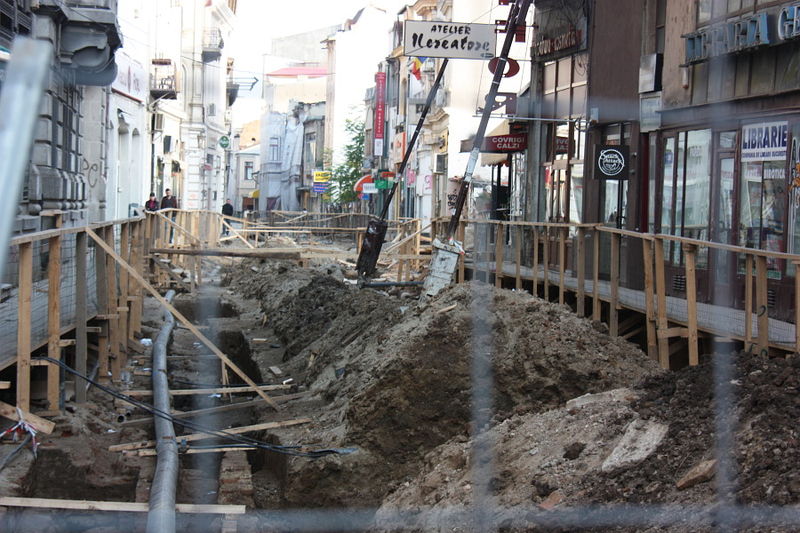
Lipscani area in downtown Bucharest during gentrification. Source: commons.wikimedia.org
[1] Sharon Zukin, Loft Living. Culture and Capital in Urban Change, Baltimore & London: The Johns Hopkins University Press, 1982.
[2] Liviu Chelcea, Grupuri marginale în zone centrale: gentrificare, drepturi de proprietate și acumulare primitivă post-socialistă în București [Marginal Groups in Downtown Areas: Gentrification, Property Rights and Primitive Post-Socialist Accumulation in Bucharest], Sociologie Româneasca 3-4, 2000, p. 51.
[3] Liviu Chelcea, Grupuri marginale, p. 63.