


Faisal Abu Al-Heja is a 23 year-old actor and political activist. He was born in the refugee camp in Jenin, Palestine. He graduated from the Acting School of the Freedom Theatre and took part in most of the projects of the theatre in recent years: Animal Farm (Ferma Animalelor), Sho Kman? (What else?), Playback Theatre, Freedom Bus etc.
Freedom Theatre defines itself as “a community theatre and cultural centre in the refugee camp in Jenin, Occupied Palestine.” Starting from the belief that arts can play an essential role in the construction of a free and healthy society, Freedom Theatre offers a series of cultural and educational activities: acting schools, film schools, photography, creative writing and multimedia classes for Palestinian children and teenagers, theatre performances, film projections, debates, public protests and touring around the other cities of the West Bank. The theatre was founded in 2006, inspired by the project Care and Learning established by Israeli director Arna Mer-Khamis, who set out to use theatre as a form of treating the depression and post-traumatic stress disorder that the children from the Jenin camp had been diagnosed with (David Schwartz).
I would like to start with your personal experience with Freedom Theatre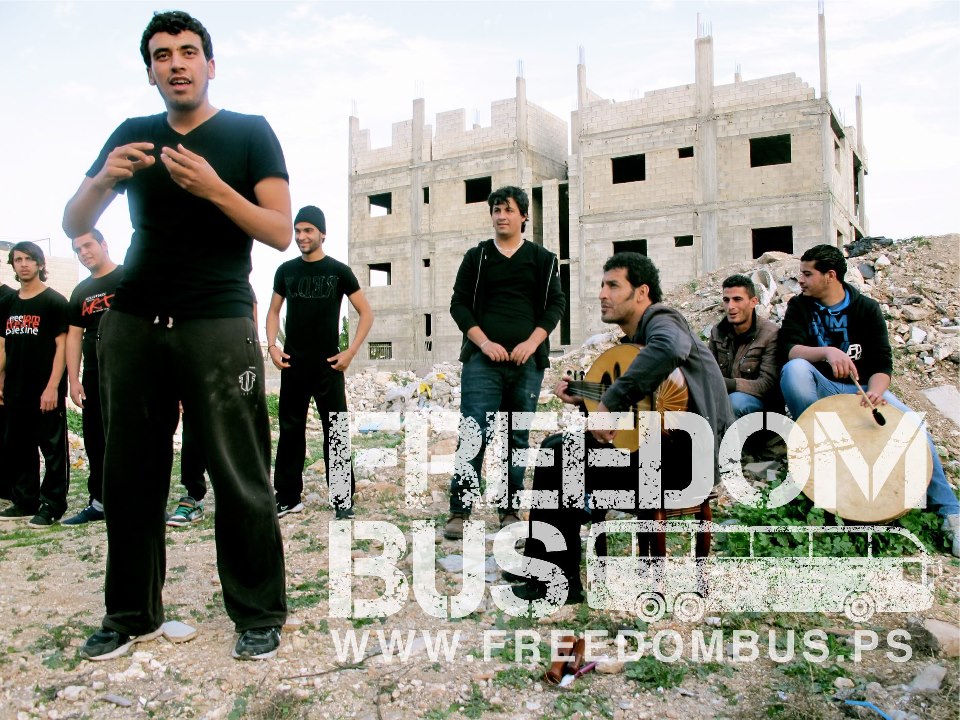 .
.
The first thing, I am born in Jenin refugee camp and I still live there. And during my childhood I wanted to become an actor. I wanted to be an artist. This is a very big dream for someone living in the camp. because there was no space for something like this. We did not have the chance to study or to learn, we just did some theatre in school, but there was no professional theatre. After I finished school, I heard about the Freedom Theatre, about Juliano Mer-Khamis and his mother, Arna Mer- Khamis. And suddenly I wanted to go to the Freedom Theatre, but at the same time I didn’t want to go. Because the people were afraid and worried about Freedom Theatre. Because in 2006, following the second Intifada, it was a tough period in Jenin. Many people were killed, the Israeli army was coming every night to the camp to arrest people. And the people believed there were Israelis in the Freedom Theatre, they thought Juliano may have been a traitor. But finally I decided to go and meet Juliano, and we talked about theatre and about art in general and suddenly I realized I wanted to be part of this group. Juliano gave me an amazing answer, he said: “we have an acting school, we have writing courses, photography classes – what do you want to do?” I was shocked to hear this and I said: “Wow! And everything here in the camp?” So I joined the acting school. And day by day I started to feel more committed to this place. I realized that we are not only artists! We are also freedom fighters! From our stage, through our art, we give the people, the children of the next generation, space to dream. Because from my experience I know it is so hard to dream. And that’s why I want to offer them this opportunity.
How is the situation now? Do people know the theatre, how do they relate to it?
I use myself as an example because they all know me here, since I am born in this camp. Now everybody knows the theatre, many people changed their minds and are part of our audience. But not all of them agree with us, there is some mistrust in our community. But we’re trying to improve things, especially for the girls. In the beginning it was hard to get any girls to the theatre. And that’s because during the Intifada, the people were like prisoners in the camp, they couldn’t go out and they were afraid of anything from outside. But now we have many girls involved in our projects.
Yes, I’ve also read that at some point there was some tension between the theatre and the community regarding the presence of women in the theatre. Is this true? And how do you deal with it?
This is not easy for the people. Because there are many aspects: there is the religious part, Haran, and there are also the traditional rules according to which girls are not allowed to perform. And then, there is a third part, made up of people who thought that the theatre would be committed to the Israeli side. It’s true that there was a little bit of tension at the beginning, but what we’re trying to do is to produce a good performance that could work as a model for the people. For example, from my personal experience – my friends didn’t like our work at the beginning , my family was especially against it. But after they saw me performing for the first time on stage in Animal Farm by George Orwell, they were surprised. It was a big production, with costumes, with lights, exactly like in a real theatre. They were also impressed with the way we had adapted the play for the Palestinian context. And the audience was touched. After the performance they came to me and they told me that it would be great to teach the children about the revolution through theatre. My colleagues had similar experiences when they produced a movie or they opened a photo exhibition. This is how you can feed the people and to tell them: look we’re not joking here, we’re trying to keep our cultural identity alive! As you know, our belief is that that our third Intifada will be a cultural one.
So what you are emphasizing is that the revolution through theatre and arts is becoming more important than the people’s relation with tradition or religion.
Yes, and there is one more thing. During the years of the Intifada the people felt miserable. Because people were being killed every day, and every day people would become prisoners in the Israeli prisons. And this made us to see things just from one angle. And we didn’t have the chance to see theatre before. I also hadn’t seen theatre before my experience with Freedom Theatre! But when you give the people space to experience art, they will love it and they will believe in it.
In this context, what is the relation of the Freedom Theatre with the political authorities, both with the Israeli and the Palestinian Authority?
The Israeli authority doesn’t like us that much. The Israeli army especially. They think we are terrorists but from a different side, with a different approach. They have attacked the theatre many times. They arrested people from the theatre, our technician, our local manager, they arrested me last January. Also, when our friends from abroad come to visit us, if they say at BenGurionAirport that they are going to the Freedom Theatre in Jenin, they will have problems entering the country. They want the Palestinians to go and face them, and since they are a professional army they could kill them easily. They are the occupation forces, so they will not make our life so easy. They also want to make people afraid of the theatre – for example if you live in the camp you will not send your children to the theatre because you know that the Israeli army is always there, arresting people… With the Palestinian Authority there is also tension, but in a different way, like for example when Zacharia al-Zubaidi was arrested. But it’s different, because the Palestinian Authority has no authority. They can’t protect me from the Israeli army. They can’t stop the Israeli army from entering Jenin. In the media you see Palestinian Authority, you see them claiming human rights at United Nations and so on. But that’s a joke! If you come to the streets things are very different. But I have to mention that after our project, Freedom Bus, they called us from The Foreign Affairs Minister of the Palestinian National Authority. And they were very happy with our work. But our relation with the Palestinian Authority is always changing. Sometimes they support us, sometimes they are against us. Even if they would calls us now to say to support us, sometimes we still feel they are actually against what we’re doing.
But why do you think they are against you?
Well, for example, after our performance, Animal Farm, they called the director to interrogate him. I have to say that we invited them for a special performance, two years ago. And they didn’t come. To be fair, I can’t say they are totally against us. It depends on the person that would talk to you. But I also have to say that after Freedom Bus there is an improvement in our relation.
Do you think that they also understood better what you are doing?
Yes, that is a good point, because they are also a part of Palestinian society, a society which refused the theatre at the beginning.
“Our fight is against the people who take our freedom away!”
So what do you think or feel is the most important change in the last 6 years, since the Freedom Theatre started its work?
First and most important change is that we have our space where we can dream, where we can test our ideas and our creativity. As Palestinians living under occupation for 63 years we can say from the stage: “Hey guys, we have rights here! We are human!” Another change is that we are becoming better trained and more professional. We also built many friends all over the world. And we could say that Freedom Theatre is our window to the world. If you want, we can take this example – this interview via Skype. If it wasn’t for the Freedom Theatre we wouldn’t be connected and you would not have heard about me. Children were used to think only about death and killings, now they can direct a play or they can make a movie and they represent Palestine abroad. But not that Palestine from the media, but the real Palestine. All the media show us as terrorists and Jew-haters. But this is not true! Our problem is the occupation. Our fight is with the people who take our freedom away! You know, I live in Jenin. Between Jenin and Haifa there is one hour distance by car. And there is the sea in Haifa. And I have never seen the sea in my life! It’s just one hour but I can’t get there! I can’t do that because there is a huge wall and I’m not allowed to enter, because I am a Palestinian.
My next question regards the people working at the Freedom Theatre. How many of you are Palestinians and how many are foreigners or non-Palestinians?
Our staff is made up of around 25 people who are Palestinians. The number of foreigners varies very much. Sometimes we have a camp for volunteers and we have many foreigners here. Some of them stay here for one year to work on a project.
From my point of view, the fact that the theatre is run by Palestinians is very important.
Yes, as I told you, we give our best to be more professional and more experienced. For example, I studied acting and now I am an actor. So today we could work together, we could do anything.
How did you deal with the death of Juliano Mer-Khamis, how did you reorganize things after this?
We lost our teacher, the best teacher you could find. He was really the leader, a crazy leader who came to the refugee camp and built a theatre from scratch. At the beginning it was very hard for us, especially because after his death, many people left. Suddenly the embassies started to call people telling them that they are not allowed to stay in Jenin, because it is a dangerous aria. So we told ourselves: “Look, we can cry forever but now we have a big challenge ahead of us! Juliano died for us, for our cause, which was also his cause. So we must do everything to continue his work.” Together with our director Nabil al-Raee we produced a performance called Sho Kman? (What else?). And we got invited on a tour to Germany, Austria and Switzerland. And we saw this performance as a gift to Juliano. Many of us still think that his soul is here with us in the theatre. Because he always gave us energy, he always pushed us, he was an amazing example for the real fighters, for freedom fighters. I’m not saying that everything was easy after his death, but sometimes when you want to do something, you can do it even if it’s hard. o I think we’re doing well now, everybody came back to work and everything is organized and back to life again.
“What did I do wrong to be born in a refugee camp in Palestine and not even be allowed to see the sea?”
And how was for you the experience of traveling abroad to Germany, Austria?
Oh-la-la! It was amazing! This was not the first time for me, I toured before with Juliano in 2009, also to Germany. The first time I travelled out of Palestine, it was amazing. Europe is very beautiful, but at the same time I asked myself: what did I do wrong to be born in a refugee camp in Palestine and not even be allowed to see the sea? In Europe people are free, they can travel everywhere without visas and without checkpoints. But at the same time traveling abroad gave me a lot of strength. Because we met people who believe in our cause and who support us and who listen to us. And that is very important. They saw that we are not only terrorists, they saw that we have artists, we have directors, we have film-makers. But it was hard for me to travel without Juliano, in 2011, two years after we traveled together. It was very difficult, especially that I had to go to the same places, to the same theatres. I felt I had a greater responsibility. I remember that during the tour in 2009, Juliano came to me before a performance and he told me: “look Faisal, don’t worry, if you make any mistakes, the audience won’t notice; they don’t know the play, only we know it.” It was a large audience. And in 2011 we came back to the same theatre, back to the same place. And I needed him, I needed someone to encourage me. So I watched some of Juliano’s speeches and interviews on You Tube. And this really helped me. And I said to myself watching Juliano: “This is for you! Don’t worry, everything will be fine, we will do our best.”
I think this is the most important thing that you as a theatre, as a group you have found your way to continue without Julianor. My next question regards your theatre work with the children. How do you work with them?
Here, at the theatre we have many courses. So we make advertisement for these courses in magazines or we talk straight to the people. But we make different groups according to age. We don’t mix children with high-school boys for example. .So we work with several groups of age but separately. Also, when we do a performance, we go to the school and high-school to them here, we also go to the villages around Jenin, because we also want to build a relation between them and the theatre.
So, can anyone join you? Are there any selections being made?
Everybody is welcomed to the Freedom Theatre but it’s important to be entirely committed to it. It’s not easy to be an actor We work with people who want to be artists and also freedom fighters. But a lot of people come and join us, and graduate our courses as photographers or film-makers. And we are hoping to bring even more people.
Now I have one last sort of personal question. Because we are talking about theatre as a means of resisting the political regime, which in your case is the occupation, I know that you have been arrested and I would ask if you’d like to tell us something about this episode.
It is actually an amazing story. I don’t remember which day, but it was in January this year. During that time the Israeli army came every night to the camp, they arrested some people, took them for nine or ten hours and then released them. So we decided to make a theatre performance about this. We decided to do a playback piece. We went to the street and interviewed some of the people who got arrested. And then I had to play the role of the conductor. People would tell their story and our actors would right away transform the story into theatre. And one night I woke up at two o’clock and I found a soldier in my room. They jumped through the window in the house. . . Suddenly they tied my arms and they took me to walk around five hundred meters. And they took me right to the place in the street where we had the performance. But they didn’t ask me anything about the performance. I didn’t know if there was any connection or not. And at that place where we had the performance they also blindfolded me and took me to prison. And they released me the next day. There is this place called Jellamy, where they kept me from 2 o’clock in the morning until 1 o’clock in the afternoon. After six or seven hours with my hands tied they came “to be nice”. They untied my arms and they started to ask me about the theatre, about Juliano, about life in general… But the funny thing is that one day I was acting in this place performing the role of a prisoner, and the next day I was the prisoner in the very same place.
This is an amazing story indeed. Thank you very much.
Interview done by David Schwartz.