


by Valentina Iancu
 Andre Breton’s concept of revolutionary surrealism was introduced in Romania by a group of artists and writers gravitating around the magazine unu. Founded and financially supported by the military doctor and poet Saşa Pană, unu was the longest-running surrealist magazine in Romania. All the published works followed the two defining directions of surrealism: the Freudian-inspired automatism and left-wing activism. Uniştii (Victor Brauner, Marcel Iancu, Geo Bogza, M.H. Maxy, Saşa Pană, Ilarie Voronca, Claude Sernet) took baby-steps towards positing the socio-political determination of art. Throughout its activity, other young artists joined the initial group and radicalized the endeavor of the unu surrealists. These artists’ choice for revolutionary surrealism gradually took the shape of a thorough rebellion, rejecting not just the bourgeoisie, but Italian fascism as well. The most important aspect of their positioning was finding a common denominator for their different understanding of certain social realities that did not fit in with the values of young, humanist intellectuals. Their art can be brought to a common denominator of surrealist aesthetic preoccupations which originate in theories that ultimately aim to valorize the liberation of the unconscious.
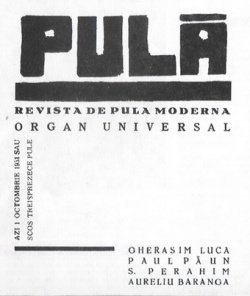
After their debut in unu, at the insistence of Saşa Pană, Jules Perahim together with Aurel Baranga, Gherasim Luca, Sesto Pals and Paul Păun found the surrealist magazine Alge. They form impromptu groups of artists whose activity relies on socio-political activism. Their enterprise was often severely criticized by nationalist thinkers, whom they provoked through their radical actions. In 1931 the magazine Pulă. Revistă de pulă modernă. Organ universal [Dick. A Magazine of the Modern Dick. Universal Organ] is published as a single issue of which 13 copies were printed, but not publicly distributed. One of these 13 copies reached politician and historian Nicolae Iorga[1], with the message “You got one? No, you don’t.” As a result of this action, they are accused of “pornography” and “attack on morality.” Although underaged, they spend 10 days in Văcăreşti prison.
The young Romanian surrealists laid the foundation for a new direction on the Romanian art scene: political activism through artistic means. Scandal, irony and vulgar language were all means by which the surrealists questioned the social issues of the day. The issues of the peasantry and of the workers had never been tackled in art before, most artists being interested in the beauty of the work, not in the honesty or the relevance of the message. By means of outrage, surrealists managed to launch a provocation: artistic creation with a strong political content.
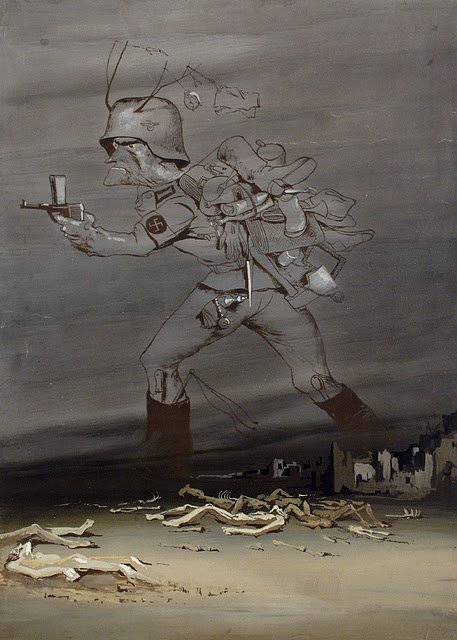
Jules Perahim – Plecarea in permisie a unui soldat fascist [A Fascist Soldier Goes on Leave] (Arhiva MNAR)
1 comment
Super material si articol, felicitari Val!