


Interview with Irina Vacarciuc
CasaM is a theater performance dealing with the lives of women who have been victims of domestic violence in The Republic of Moldova. The performance developed from interviews conducted with women from villages across the country, it premiered in 2010 in Chișinău and it was staged in over 40 villages and small towns in Moldova. The cast is made up of Snejana Puica, Mihaela Strâmbeanu, Ina Surdu, Irina Vacarciuc, directed by Luminița Țîcu. I talked to Irina Vacarciuc, an actress on the independent scene, about the performance and the interaction with an audience unfamiliar with theater performances (David Schwartz).
In Romania in recent years, some artists have begun taking performances to small towns and villages across the country. I’d like to talk to you about your experience with CasaM. How did you get to perform in those venues and how did your first encounter with the audience go?
The performance is funded by the OSCE[1] and they were the ones who came up with the story and with the proposition for the performance. We staged it three times in a row at Ginta Latină, because they wanted a large venue. The OSCE also suggested we stage it in the countryside. I hadn’t performed in the countryside before. I remember we were in Căușeni and during the post-performance discussion, somebody asked: “How dare the director wear pants on stage?” This was her biggest problem. I mean, the violence against women was one thing, but how dare she come out on stage in her pants? This was my first shock. I couldn’t imagine that after this performance, the most disturbing thing was the director’s pants. It was the weirdest reaction I’d ever witnessed.
How did people generally react, though? Were there mostly grown-ups and older people, or were there kids as well?
The first tours were somehow better organized and we performed in larger villages or in small towns which had a community center or a school and we had people from neighboring villages brought over on the bus. They were mostly grown-ups, elderly folks and teenagers. When people brought their kids along, Luminița, the director, would stay outside and play with them so that the others could watch the performance. There were all sorts of reactions during the performance. At one point in the play, I’m eating oats. And I kept hearing from the audience “Bonne appetite!” or “Enjoy!” And there’s also a story about someone taken to Turkey without her consent – she was being trafficked – who talks about climbing out of her hotel window on the 3rd floor, falling and breaking her leg and spine. The actress tells this story while on a bike and she goes on about her broken leg, when someone in the audience says: “How come you’re talking about having a broken leg while you’re riding a bike?”
To me, it was very stressful. It was my first time on a national tour and I didn’t know how to react. Our performance was basically a struggle with the audience. You had to shout, you had to be as rough as you could and try to be in control. You had to pay attention to everything happening in the hall.
I find it very interesting that people reacted in a very naturally and in a lively fashion, not the way those who are used to the theater usually do.
I agree, but we just weren’t used to that at first. We didn’t know whether to stop or carry on, we had no idea what to do.
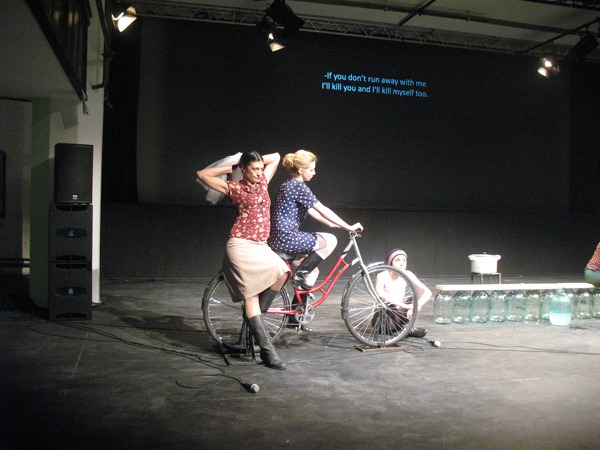
Scene from the performance. Source: theatre-cultures.com
Did you try to have a conversation with them during the performance?
No, not during the performance. But there were moments when certain lines from the text were very suitable, so I emphasized them. I took advantage of certain lines in order to have some sort of a conversation with them. We did a lot of shows, 5 tours, 8 performances for each tour. One of these tours was funded by the foster home “Amicul” and those performances were very well organized, in the sense that people knew what they were coming to see. The people from “Amicul” talked to the local social workers, who in turn talked to the people there and the audience was somehow prepared. Even if mothers came with their children, they knew what the performance was about. The performances funded by the OSCE were relatively well-organized at first, but I’m sorry to say that it gradually became just another activity to get through as quickly as possible. One time, 2nd and 3rd graders came to the performance, and Luminița asked them what they were there for and they said they came to the concert. So the organizers didn’t even bother to tell people that the performance was not suitable for children. The OSCE was basically checking another box on their activity roster. They receive some funds and they have to spend it.
What do you think of the audience in these small towns? Are the people interested? Can they relate to the stories?
It’s really complicated. I think people do relate, but their reactions have to be understood in their local context. For instance, one time we asked the people how long had it been since they last went to the theater. And they told us no theater performance had come to their town since 1989. We didn’t understand why they were laughing, why they were moving around during the performance, why they were noisy, and we got upset. But it was actually understandable, because they had never seen a theater play before. You can’t blame people for reacting this way or that way. And really, their reactions vary significantly. Sure, when you’re up there on stage, doing your thing, it annoys you that they laughed and “ruined your monologue”. But if you think about it, the audience laughing doesn’t mean they can’t relate to the story. It could simply be a defense mechanism, because people go through a lot in life and react in different ways. Maybe those who experienced such hardship have different reactions. Maybe to them, these stories sound like a walk in the park compared to what they’ve been through. So even if they laugh, I think it’s because it touches them somehow and they can relate to the story. […]
Interview conducted by David Schwartz
[1] The Organization for Security and Cooperation in Europe, made up of 57 member states from Europe, Asia and North America.