


by Costi Rogozanu
I attempt to answer the question “Why is there not enough literature about marginal groups?” with my own cheap rhetorical ploy: “Why is there not enough literature?” We have literature by the gallon, but, with only a few exceptions, I find that the tons of published fiction keep floating in two distinct bubbles: the aesthetic chimera and the commercial one. Writers in the first group have old-fashion dreams, they reject any trace of manifesto, any sense of urgency dictated by the present and, in blatant disregard of their own aesthetic ambitions, they reject the lessons of realism served up by great writers in the past two centuries. Writers in the second group dream of inventing a Romanian commercial literary language. It’s not a bad idea, but considering you’re dealing with a huge market exercising pressure very effectively on the reader at a global level, it’s even more work than writing an aesthetic masterpiece.
My pitch is not for a type of literature written according to a rigid social program. I’m not thinking of quotas on literature about the Roma, LGBTQ, migrants etc. My problem is that we seem to be missing the tremendous stakes of realism in literature. We have few writers with an obsession for the real, for the truth – in the most old-fashioned and boring sense of the word. Having a knack for the real doesn’t necessarily mean having a knack for squalor (Radu Aldulescu sometimes falls into this trap, but his last book, Cronicile genocidului (The Genocide Chronicles), is what I’ve been expecting of him). It doesn’t mean having a knack for a certain issue which interests us politically. Schiop’s Soldații (The Soldiers) is a good book because it has that vintage obsession with recording reality (the gay theme is a only a side note, part of a larger obsession and a correct understanding of literature – that’s why he insists on calling it a love story, not a story with a certain direction). Dan Sociu’s delirium from Combinația (The Trick) is also an explosion of frustration in an ocean out of touch with reality. The exasperation caused by this void of reality triggers experiments such as Combinația, wherein the guy pours out his rhetorical delirium as a wake-up call. When people start shooting up fantasy films and the likes thereof, they do it out of the excess of reality they think they’re consuming. The answer to abuse is escape. It’s obviously NOT! But just as obviously, it works: after a crappy day at work, I’d watch the whole Lord of the Rings series.
Only out of a realist scheme of receiving and writing literature do the marginal and marginalized eventually show up. This is how we get to the paradox some great thinkers on the left never understood, namely that you can have novels extremely relevant for the “left-wing eye” written by conservatives. Right now, I’m reading Franzen, even if some of his interpretations of current events boggle the mind. But the man is obsessed with capturing everyday struggles. Incidentally, he writes one novel a decade and tries to capture the essence of each period. So far he’s succeeded in doing that with two novels. Eugenides is also a good example. In Middlesex, one of the stories of the main character is the recovery of sexual identity. However, he/she isn’t floating exclusively in this fish tank (although at one point, he/she actually finds him-/herself in a fish tank), but in a world where social cleavages appear quicker than lobbyists in the European Parliament.
How can the literary glasses of the new generation of writers be changed? By cementing the social dimension (vague, I know, but increasingly understood by many kick-ass artists) in literary criticism. It’s enough to open your eyes, turn on your desire for artistic communication, for the production and reproduction of new realities and thousands of sidetracked issues will surface. Social literature is not a requirement for ideological lobbying, but for refining and adding depth to the discussion. A good novel capturing the issues of migration will have to be more than a tearjerker or an NGO report. A good novel tackling rural poverty will have to go beyond stupid urban ironies, but also beyond the teary swarms of philanthropy. In order to do that, artists should get a taste for ideological fighting. Because we might wake up to find libraries stacked with the fashionable downtrodden groups, but with no real gain in artistic expression. And there’s also the question of inventing or gaining a new audience. I think there’s room for that, too, but it might be a good idea not to conveniently bore that audience either with aesthetic chimeras meant for the juries who don’t understand today’s “tricks” anymore, or with attempts at commercial jackpots which barely rise above the usual crap delivered by the multinational publishing houses.
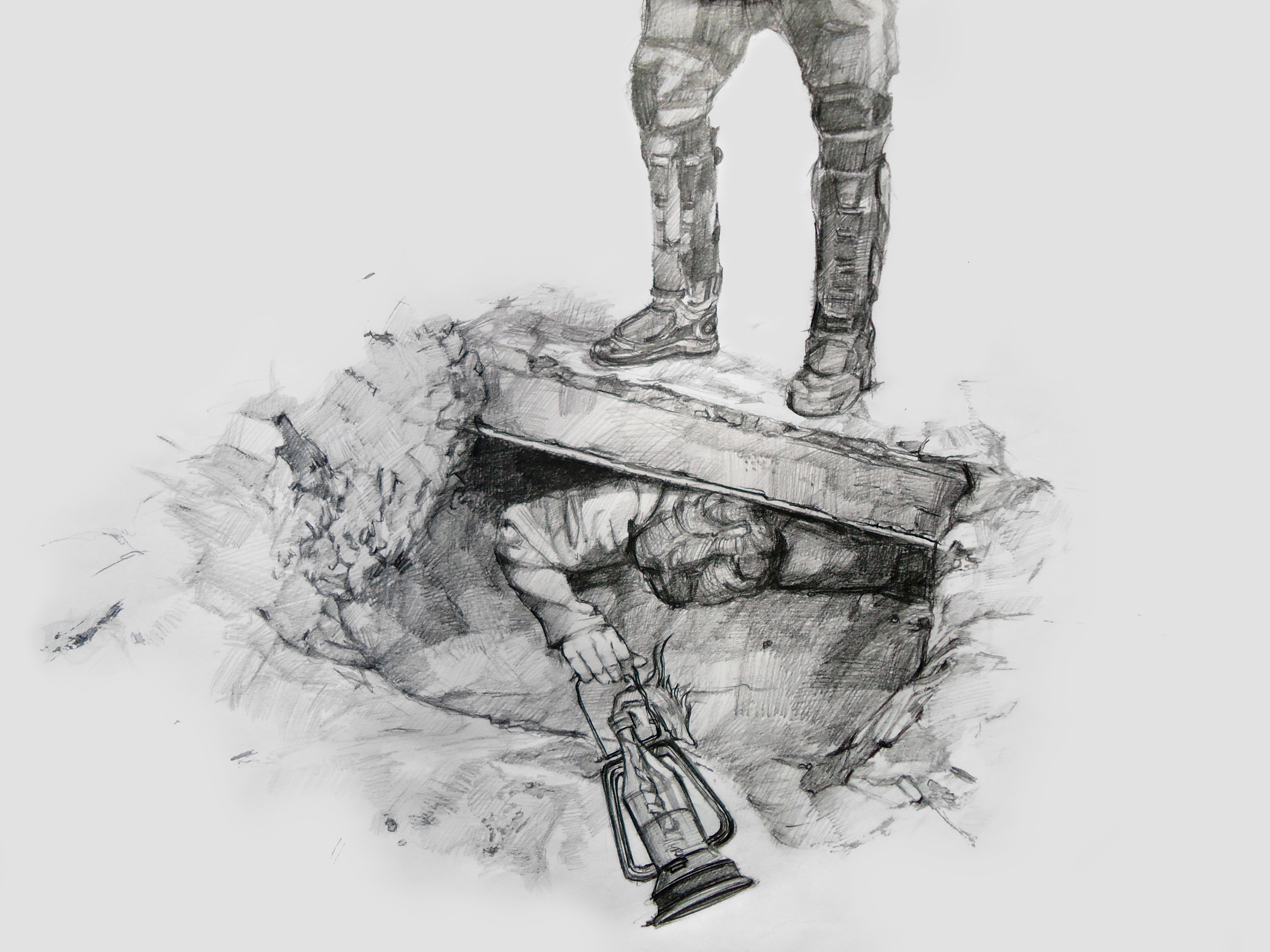
Laurențiu Ridichie, No Title, 2012.