


Marta Talacha
In 2013, Marseilles became a European Capital of Culture – to the awe and discontent of other French cities, but to the joy of intermediaries and speculators in real estates. The second largest city after Paris, first in inequalities and social divisions, leading in poverty and its nearly 40% unemployment, the town has built its identity on a coexistence of many cultures, races and religions.
Immigrants have been forming the pulse of life here for ages. Armenians escaping the Turkish holocaust, Italians fleeing fascism and poverty, North-African Jews, pieds-noirs or Algerian repatriates, resettlers from Tunisia and Morocco. Here is the largest seaport in France, fifth in Europe. The spot of passage, transfer, random or ultimate migration. The Gateway of the Orient.
Following the all-european trend, years ago the city had begun shaping its new urban space – it was supposed to shine, amaze and attract investors.
The price was the gradual exile of the lower class and the poor to distant suburbia: ghettoes of housing blocks, the cités, which politicians had once provided as a gift to the society, in order to locate cheap workforce and poor immigrants there. Today, they are fortunately distant, beyond the scope of an Old Port tourist, beyond the range of vision of marketing. Today they are there to sweep desperation, unemployment and social inequalities under the carpet.
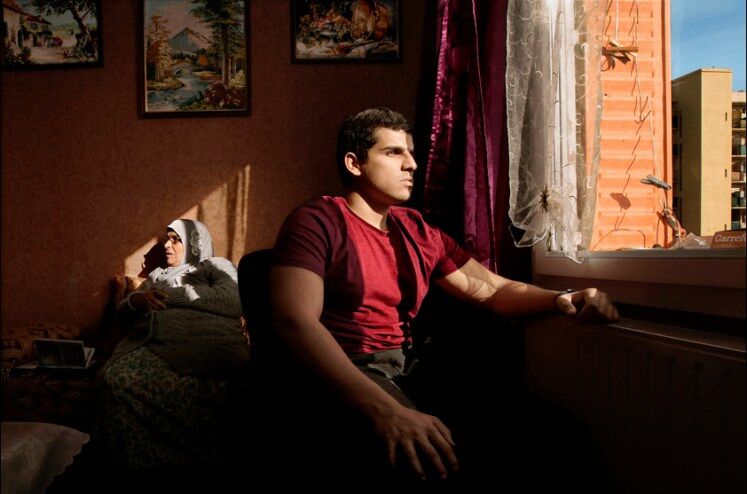
Photo: Bharat Choudhary, Silence of the Other – Marsylia, 2013
Marseille-Provence 2013, or the European Capital of Culture
Together with other investments aimed at transforming the downtown and make it a touristic postcard, the event of Marseille-Provence 2013, or the European Capital of Culture MP 2013, sealed the process of systemic expulsion of people from the downtown and of taking apart any authentic character this place used to have.
But there was more. The MP 2013 organizers surprised all with their arrogance and disregard to the inhabitants, potential participants of that grand feast, pushing local artists and small associations aside, while implementing a policy of taking comfortable, and, above all, commercially viable, decisions. Viable not for all, however. Viable for officials seeing culture as a tool and a mean of promoting the city, for the purposes of increasing sales mostly. Culture for all? In what form?
MP2013 left all no choice of either entering and becoming a part of the show or staying hush and sitting at home.
Obviously, there were grant funding options, open discussion panels, a lot of fuss and many hopes aroused. All according to the guidelines. A nicely and modern packed Pandora box, labelled with a shining slogan close to the hearts of many: Culture.
It was soon to be found out, however, that the participation of bottom-up organisations and associations was to be fake: everybody got their lollipop to calm down, while the biggest cakes remained shut in the fridge.
A lack of a wider paricipation in major decision-making, a lack of common planning or thinking of culture as a value, not an exported product, was visible. There were no community-related or local perpectives or thinking. The “Ephemeral Gardens” project, apparently planned as a show-off of a cooperation with local activists (working daily as volunteers), concluded in excluding the latter – nine NGOs in total – because in practice, they were unable to influence any decision. Those people had refused to partake in creating a temporary garden of arts for 420 thousand euro, which was to disappear after 2013.
Such scandals were plenty. However, the problem was mainly in ignoring the inhabitants, invisible as they worked in bottom-up organisations and urban movements – unpaid, driven by sheer passion and need for action. Those people ceased to exist for the city in 2013.
The party was splendid and hard, like a wedding reception of a poor cousin, whose parents had borrowed money for years to pay back, with the aim of the table being full and the liquor bringing calm and shooing off any doubts, for one night. The wedding reception concluded with some memories, a debt to pay back, a self-satisfaction or a hangover on the part of some, and several empty bottles under the table.
Whom and what was the party for?
Your future is subject to market speculation
I come across an article on Marseilles in Gazeta Wyborcza (31/10/2015, Tramwajem po Marsylii), saying it is nice and smooth, trams running fast on their rails, not blue but white, pure, untainted; speaking of “changes”, of a new modern style creating a beautiful urban climate. A touch of authenticity is here, too – fishermen with their old boats! This is an openly touristic perspective, exactly what the team of city officials and a handful of real estate investors strive to create.
The tram lines were built where it was completely aimless, as a metro line had been covering exactly the same route already, while the uptown remained deliberately cut off from the grand world of beautiful changes. This knowledge, however, is not necessary when expressing amazement with a prop bought from world-renowned architects. Such is the aim of this transformation.
The better-off inhabitant has also become a tourist. Never before interested with museums, he or she starts their local travels: a walk around the elegant, state-of-the-art Mucem – the Museum of the Civilisation of Europe and the Mediterranean, at 1 pm each Sunday – that is what is trendy!
Mucem, inseparably associated with MP2013, was founded out of the need to create spectacular objects, which you can inaugurate and claim: “Marseilles is not only the city of criminals and Kalashnikov rounds. Here we have culture, as here we have Mucem!” Nevermind that Mucem had stood empty for months (including the day of its pompous opening), or that even today not many wish to watch its expositions. Because it is all not about exposition. It is just about the concept, the momentum, the scissor-cut of the ribbon, the presence of the mass-media, and there you go – a concrete openwork, a surname of an architect, spectacular lighting, a glass trap – the illusion of change.
What was spectacular were also the costs of the construction: 300 million euro (for comparison: twice as many as the Stadium in Wrocław). Today, Mucem is experiencing management trouble, concerning not only the building, but its personnel as well. The goal, however, was achieved: to add a stunning accessory to the urban space, to impress the outsider, but also the resident of one of the so-called better districts, desperate to seek the new. And possibly, the authentic fisherman with his boat could also be fitted into this ready-made postcard. All can be done.
At night, this artificially created area dies. Just like its entire neighborhood. Gates are locked, the tram sleeps in the depot.
It is still Sunday, we are stepping forward. A lunch in a waterfront shopping mall. Because also the malls are pretty, fresh, scented, with an exclusive view to the sea. It is here that passenger ferries leave their guests – the docks are connected to the mall – so that they fill their bags with products and return aboard. A recently built shopping centre “The Terraces of the Port” completely wrecked the historical aspect of the coastline around the port, and it took away any chance of creating a space for the inhabitants of the neighborhood, like a recreation area. But who cares about the inhabitants and their needs – this is where they need to be removed from. They are so usual, neither businesspeople or hipsters, they don’t always wear smart suits. Often they are migrants. They do not match the image of the city prepared for the outside. Although this Mediterranean metropolis has been formed in one third (!) by the migrants, for ages!
“The Terraces of the Port” are a successful attempt of transformation aimed at a profit, against the inhabitants, against those who had created the multiethnic cultural melting pot over centuries. Of course, many of them unconsciously flock here as to a giant temple of luxury.
The goal was achieved – to support the interests of the few who sell and trade the city as their own commodity, under the slogan of liberal free economy, under the slogan of growth and the need of change. And all naturally formed places of the everyday, neighbourhoods familiarized from year to year, the well-known paths, the traditional referrences – they cease to exist.
Indeed, the image of the Marseilles who has implemented wonderful solutions and is getting prettier, is what can be seen by someone who looks only at the shell of the egg, who polishes it until it shines painfully. No flaws or fractures are allowed to be visible, never mention what might happen if you broke the egg and saw if the yolk is not black. It is not only risky, but exposing for some painful all-european tendencies.
Cities are to serve the upper middle class, cleared of unphotogenic industrial workers, the unemployed, or – what would be worse – migrants of various backgrounds. The downtown is to be a magnet for investments, not a home for the poorer population.
Such is the new way to construct spaces, and, above all, to impose a philosophy, a style of living, of everyday functioning, and a quality of human relationships. The citizen-city dependence is being defined by the politician, the city official, or the businessperson.
The living tissue of the place, which a multicultural assortment has formed over 2600 years, is ceasing to breathe, chocking under the slippery glass of the showcase put over it. And the organization of the European Capital of Culture has been hung above, like a shining, flower-decorated guillotine.
Sorrow is now growing in our streets
The specificity of Marseilles and a rarity among other French cities, is the multicultural society, the major part of which is (still) inhabiting the very centre of the town. The poorer residents are visible, they form the heart of the city, and the bustling exotic marketplace is a spot, not only for everyday shopping, but also for meeting a neighbour or a coffee chat.
To put the economical and social gentrification plan into practice, and avoid large-scale protests and demonstrations, the city has been slow and gradual in evicting residents to the outskirts, where no subway line nor a bike lane reaches. It is worth noting, that when cars and entire neighbourhoods in France went in flames during 2005 riots, a surprising peace prevailed in Marseilles. It was a very important signal of a sense of community, which at that time still kept the city together.
The media has tried to explain its infame citing the type of the community, the high immigration, or – when the extreme right-wing voiced it – the religion of Islam, the believers of which form one fourth of the population.
However, it is mainly the drug trade, silently allowed to thrive by the ruling elite; it is this business which produces victims, downtown shootings and a dozen of spectacular murders each year.
Those criminal actions did not originate in mosques or any other churches, but in rows of housing blocks, rejected and forgotten by the system. Sending police squads to cités is nothing but a fake measure of managing a still escalating problem. On a similar note, repressions create a more and more police-state society, with omnipresent cameras, regular controls and politicians, who make no secret of “clearing certain districts”. In fact, this well-organized drug business keeps the city going: from the port to distant housing projects. The mayor’s office is not interested with any marijuana legalization or any other measure of controlling the trade entirely. All that the mayor’s office wants is not to be bothered.
At times, in the vicinity of Mucem and the sea, migrants – former inhabitants or scaterred survivors who somehow managed to save their homes close by – have a picnic, ignoring the fact that the times of freedom are over. Now the neighbourhood’s grass patches are under close surveillance, targeted by cameras.
In the context of MP2013, the city has completely forgotten the presence of “culture” in the very word “multi-cultural”. That culture is inherently bound with absolute freedom: of creation, of thought, of emotions, but also of the society. That culture includes respect to local traditions, to authenticity, and moreover, to the people themselves. The communities are what was absent, it was them who were not offered a freedom of action, or any factual cooperation.
The communities of the housing-block projects, the suburban peripheries, were where rap flourished. Mighty, contesting, intelligently engaged in social life, nutritious and hard like poetry. More than once I have heardyoung people who communicated using rap, the authentic language of their street, their everyday.
MP2013 events, on the other hand, lacked almost any rap or hiphop shows, in spite of motions being filed, requesting a co-financing of such. Instead, 400 thousand euro was proposed to be spent on the organization of a show featuring a single celebrity – DJ David Guetta. The show was to be performed in a public park, and the ticket price was far from low. Luckily, owing to a fast reaction of web users, a petition was pushed and the event in this form was cancelled. Yet, the bad aftertaste, and the awareness of the aims of the organizers being distant from the dreams and the work of small communities, remained.
Cynicism has poisoned our hearts
Years before, the huge event was already rumoured to be bound to change the face of this place forever. Taxi drivers attended intensive English courses, hotels hired new personnel, restaurants prepared extra tables, and artists lived a hope that finally something will bust. Cultural and educational associations, present in a number exceeding 800, waited for an opening and a dialogue about issues, which officials usually would not, and cannot discuss. Early in January, phones rang off in every home. It was the city calling, my city calling me. An invitation to the opening, 850 thousand inhabitants. Culture for all!
The all-thirsting and the all-proof, the unbelieving and the enthusiasts, the wonder-awaiting and the observers, all left their homes. Because of a superhuman congestion, I spent that evening in an Arabic bar, eating a traditional couscous, watching a live broadcast on a TV mounted under the ceiling, with friends of mine. The Minister of Culture, Auréli Filippetti, who was proposing a toast 500 metres away from the bar, by the Old Port, gifted the burgeois with a Pandora box: 900 events, 10 million spectators, many good plays, wonderful exhibitions and artistic installations. But, coupled with that, a number of tiny scandals, magic financial tricks, political-economical blackmails, related to the lack of an adequate coordination between the organizers. Apart from that, lots of confetti and baloons, losing air right after the party. It was probably from the same box, that the chairman of the MP2013 society came about – Jacques Pfister, who at the same time held the office of… the chairman of the Trade and Industry Chamber. I guess it would be hard to speak of an unintended irony.
In spite of such close connections with the business, already in January, right after the official inauguration, hotel owners filed a request to “improve the communication strategy” immediately. Not until then was the extra million euro for communication released, in fact contrary to the original budget plan. An event of an international rank or aspirations, had not been able to cross the limits of its region communication-wise.
In his radical documentary, Nicolas Burlaud shows the introduction of MP 2013, metaphorically as the Trojan horse of capitalism, where, under the guise of culture, totally different goals are put to life. Like Trojans, Marseillans unconsciously decorate their town for a festivity and open the gates, hoping to party. Flocks of animals enter the city: three thousand sheep, goats and horses. One of the largests spectacles within MP2013, Transhumance. In fact, that is an already receding form of shepherding, practiced yet in nearby Cevennes mountains and in the Alps. And here these animals are brought to the urban jungle, to the cheers of happy crowds with their cameras. An appropriation of a dying Provençal identity turned into a street show. This apocaliptic scene stroke some as delightful, others as terrifying.
The title of the documentary, which has recently entered cinemas, «La fête est fini» can be translated as “The fete is over”. But, so as not to remain in the domain of euphemisms, won’t it be better to call it “The party’s over”? It is telling, raising a concerning question: So what is left for us, the inhabitants, apart from the handful of memories and several wedding-party bottles? Who and what was the party for?
The next urban entertainment, the Football Cup, is coming right up, in 2016. The Stadium is ready. And the European Capital of Culture will then be moved to Wroclaw – „The City of Encounters, of many cultures, of tolerance”?*
* The original title: “A European Capital of Culture with a burning effigy of a Jew in the background” refers to the next in line ECC, Wroclaw, which bases its promoted identity on multiculturalism. In reality, Wroclaw has been criticized for years of neglecting their minorities, including Romas whose encampment was brutally evicted in 2015. The same year, during one of their many marches through the city, Polish neonazis used the Old City square to burn an effigy of a Jew, in the style of pre-war hitlerites, thus showing to what extent Wroclaw’s multicultural coexistence is real and not pretentious. The city, like several others in Poland, had hosted the Euro Cup of 2012, when similar makeover projects to the one in Marseilles took place.
References:
Nicolas Maisetti, Opération culturelle et pouvoirs urbains. Instrumentalisation économique de la culture et luttes autour de Marseille-Provence Capitale européenne de la culture 2013, Paris 2014.
Philippe Pujol, French deconnetcions, Au coeur des trafics, Paris 2014.
Keny Arkana, Marseille, Capital de la rupture, DVD, La Rabia del Pueblo, Marseille, 2013.
Nicolas Burlaud, La fête est fini, PRIMITIVI, Marseille, 2014.
The mid-titles are lyrics by Keny Arkana.
The photos are taken from the webpage “Silence of the Other”,
http://bharatphoto.blogspot.com/2013/10/the-silence-of-others-photographs-from.html
Article initially published in Polish language, in Medium Publiczne
Translation by Qrde