


Interview with FLORIAN VODĂ
In 2001, at Creangă Theatre in Bucharest, I saw Vodă perform in the play Acasă [Home] (text by Ludmila Razumovskaia, directed by Radu Apostol), which revolutionized the Romanian theatre through its social and community-oriented approach and its solid poetic construction. Acasă marked the path for new theatrical practices, for profound aesthetic and political reflections upon extremely vulnerable realities, upon the world of fragile “undesirables” whose self-representation is usually shunned by the art with capital A. Acasă was created by director Radu Apostol together with a group of homeless children and two professional actresses, after six months of collective work. Through the play, “the children of concrete and dreams” were talking to the children and adults in the public about abused “under-childhoods”, about childhoods lived in the airways of the sewage system where each day was a struggle to survive. Acasă proposed a theatre of the permanently threatened precariousness, sheltered on the big stage, where the invisibles’ transformation into visible was possible, where the play could give political revenge to a marginalized reality. Where things uncomfortable to watch were confronting us with a radical sight. Face-to-face, children and adults lived the reality of being expulsed from safe territories, and the reality of decomposing the solid social body segregating the marginals. The unrepresented self-represented themselves and defined their own poetic and political position. (Mihaela Michailov)
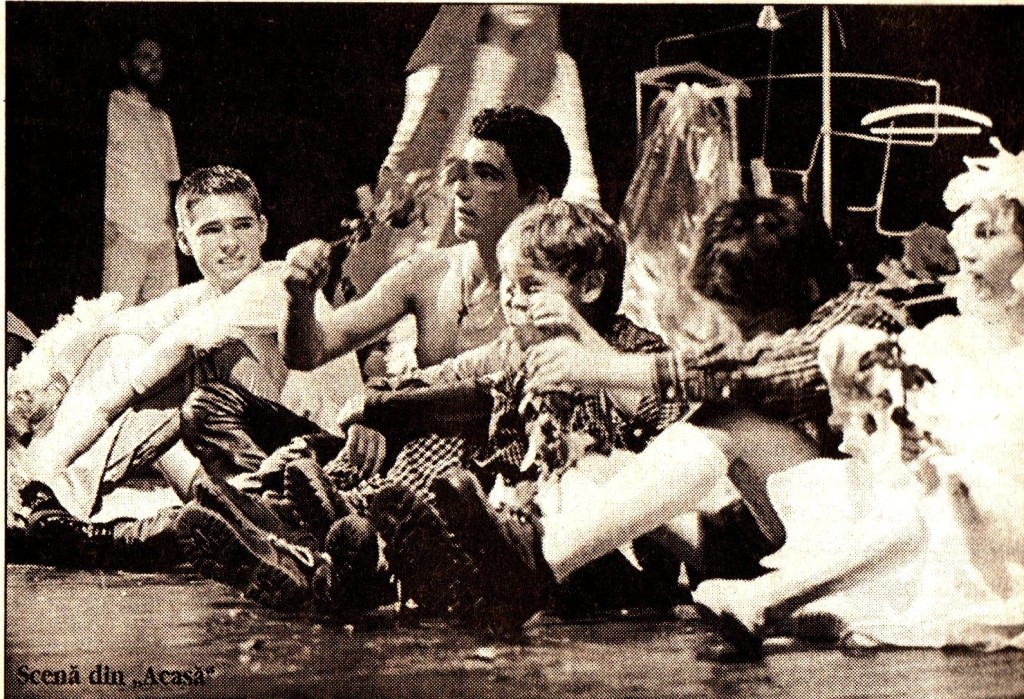
Photo from Acasă play
Tell me a bit about the period when you lived on the street. Where were you staying?
As you can realize, nothing was safe about where I was staying. I lived on the street since I was six and a half years old, until I was 17. At first, there was that feeling of total freedom, that nobody was bothering me about when I came in, when I went out, where I ate. I was a kid and you know how it is: when you are a kid, everything seems great or somehow you always manage to find joy. Of course there were also many nasty things: the policemen, who would beat you, woke you up, beat you up and threw you out of the subway, people who were trying to get you involved in all sorts of things, and so on. But all the rest was like a game, because, well, you’re a kid and you create your paradise. I was free and I did not have these values: one should have a house, one should get cleaned, one should go to school and become something… Everything was a game to me. It was “here and now”, and it was magic, because I was so young and I did not perceive everything as I did later on. I was staying around Big Berceni metro station. It was a good place because the market was near and it was easy to get food. […]
How did you become homeless?
My mother died when I was 6 and I ran away from home. I never had any connection to my dad, I didn’t feel he was “dad”, but someone taking care of me as if he wanted to believe I was his child. Later on I found out I was adopted. Dad was never there for me, I was never on his good side. I wanted to run away and escape, to become my own self. I wanted to be free. This is what I was feeling, but I didn’t know how to express it in words. This… the need for freedom. Then, around the time I turned 17, things changed. I started to be interested in girls, I wanted to be clean for them to look at me, I was watching them… Something was growing inside me, I was no longer a child. But I was dirty, and I was feeling dirty… And little by little I had to wish for a change, and that change came. I started going to a day centre around Dristor neighbourhood. You would go there during the day, wash your clothes, eat, there was a schedule, a psychologist and a social worker trying to assist you to integrate, to go to school…
So did you go to school?
I did. I had to and I went. […] At the day centre I met Radu Apostol, who was there to work for Acasă.
[…] I still remember those emotions when playing Acasă, when I was looking at the people in the first three rows with tears in their eyes and feeling our story is touching them, when we were telling them: “see, life is about this as well, about homeless children that you pass by every day thinking they don’t stand a chance. Do you understand this? This is how it is… so let’s change something! What do you say, do you want to make the change? You cannot ignore these realities forever!” It felt as if I was about to take wing! I was feeling on the right tracks. […] I have to admit that at first I was mostly there for the fun, but then I started to like it a lot and wanted it never to end. I was very enthused with everything that was happening to me. I kept being amazed! Then, in parallel, I started working with ARAS (Romanian Association against AIDS), supporting homeless and sex workers – a new environment, new colleagues. I grew up close to wonderful very dedicated people. […]
After the Acasă project, you received social housing.
Yes, and I stayed in the apartment for about seven years. At first, we were six people in the flat, and then 4 were left, then only 2. I brought a lot of people from the neighbourhood to the theatre. People who only went to the theatre when they were kids, to see Snow White, and haven’t been there since. I would tell them: come to see how it’s like! Leaving the apartment felt like falling off a cliff. For 2-3 months I stayed with a friend at Big Berceni, loading and unloading stuff for the market. I was sleeping in his small booth. Wasted life. I knew I could get away from this life, but it was hard. I learnt a lot from that experience. Then I did some time [for drug dealing, trans.n.].
For how long?
Two years and two moths. Towards the end, knowing I would be out soon, I started thinking: how will I react? Being out, it felt like I’ve been in prison for only one second, although it was really harsh there. We were 9 to 34 people in the cell. No place to sit, no place to eat, it’s like a horror movie. It’s inhuman. You cannot expect the person being locked in to become a better person; in fact, that person becomes dehumanized. It’s a total mockery. It’s like we have our evil side super-activated and we exploit it so see how evil it can get.
What do you do now?
I started doing massages; I did this at the seaside all summer long and I want to continue doing it. Moreover, together with a film director I wrote a script based on my experiences and I hope we will make a short film. […]
What do you wish for the most?
To feel good with myself, to share good vibes. There are things that I’d wish for, but, at the same time, I don’t dare to wish for. I don’t want to jump head first. I want to have a steady income, to become more socially involved, to organize painting workshops with disadvantaged kids and cool artists, maybe even a summer camp at some point. I was thinking to do massages in residential centres for the elderly. I’d like to be part of socially involved theatre projects – because the original theatre was purely social, and only later it became entertainment. I’d like to do this in order to open people’s eyes beyond their jobs, their properties, beyond what they think they know. I don’t want to own things and properties. I have a motto: if I feel good, flowers bloom out of the walls. […]
What’s a home for you?
A place where you recharge your energy. Where you relax, eat, wash up, make love if you have a partner. A place where you unwind after absorbing so much from the world outside. Everybody should have a home. Every person in this world should have a place to sleep, eat and wash up. […] There were times in my life when I just wanted to disappear. Not to die, but to disappear. I wished for the lights to go off. How could a 35-40 years old policeman wake a kid up by hitting his soles with a club? a kid sleeping in the subway, barefoot, dressed only with ragged trousers and a blouse, when it was deadly cold. How could he hit like that? That was too much for me! This is one of those things… forever imprinted in your flesh! This is the maximum evil! A man with a club beating the hell out of you because he can! I was picked up by policemen many times on the street. They would take me to the station and beat the hell out of me for like half an hour. They would hit me with their clubs as if I were a rug. I sometimes wonder why all those things happened to me; and I think only really strong people get to live things like that. I feel it’s a really heavy burden. But I managed to feel good with myself in the end. I carry a database inside. Some data fade away, disappear, some remain.
Interview by MIHAELA MICHAILOV