


Interview with Bashar Al-Kishawi
Bashar Al-Kishawi is a medical school graduate and a journalist. He left Kuwait when he was 18. He is Palestinian and for this reason, his right to benefit from higher education was denied in Kuwait. In 1990 he came to Romania to study medicine. Due to the Romanian legislation, Bashar had to choose reskilling after graduation. He became a journalist and currently works for Radio Romania. He is one of the five “voices of migration” from the performance Born in the Wrong Place. Since I am the one who tells his story and he is the first “character” I became friends with, I tried to find out more about him during the time we worked together. It wasn’t very difficult, because Bashar is very generous when it comes to his life experience. His stories are clippings of real life, never simple, always ironic, sometimes shocking. It’s the story of a stateless person. While getting to know him, I learned that many of the things we take for granted, like the right to an education in a country you can call your own or the right to see your parents, are not always guaranteed. (Alex Fifea)
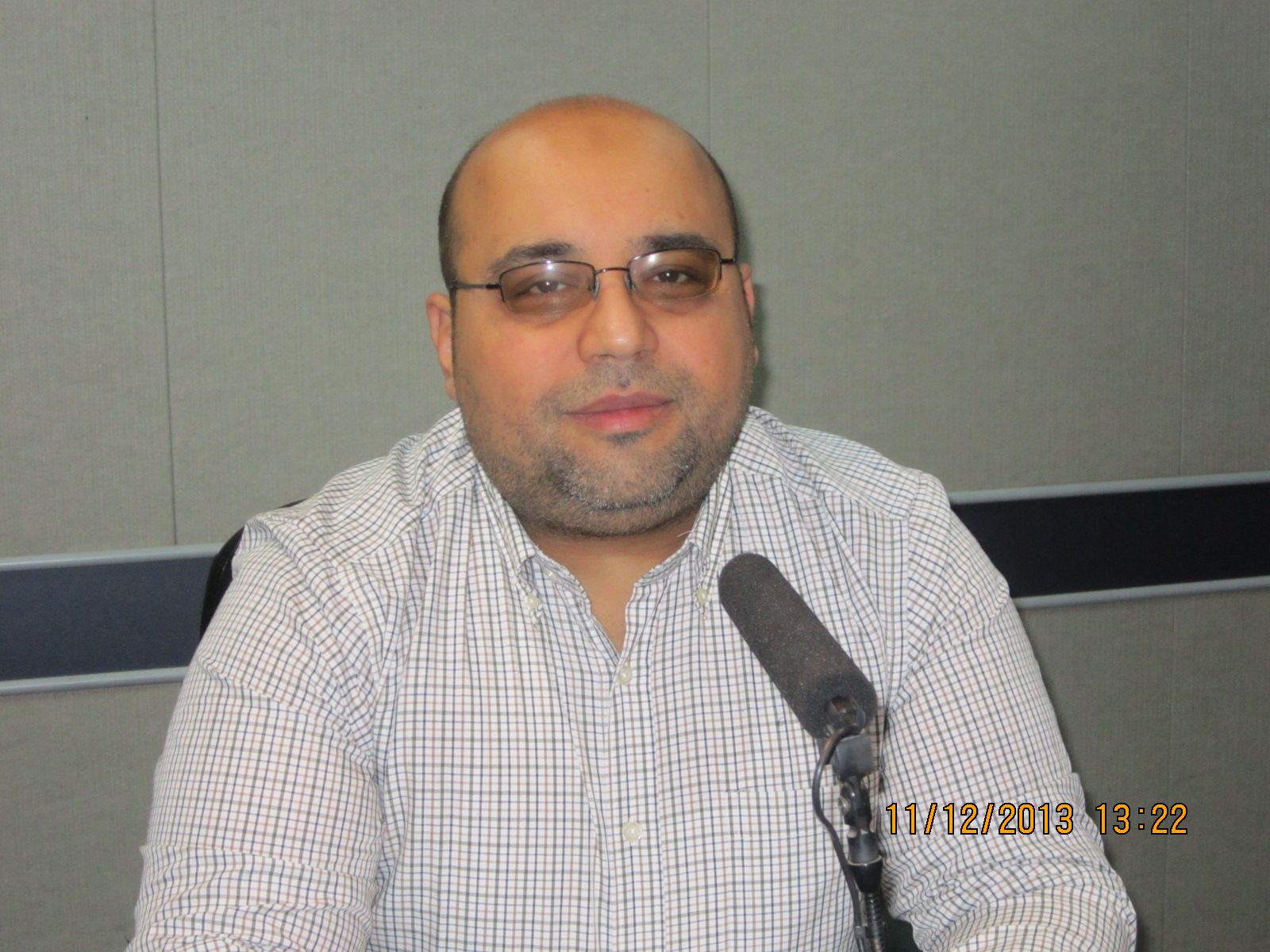
Bashar al-Kishawi. Photo: Personal archive, 2012.
What motivated you to share your life story with a bunch of people you didn’t know?
It all starts with my father, honestly. I was in Kuwait, I was a 4th grader and singing in the school choir, and I got a taste for classical music. Our choir ended up winning the national music contest, singing Carmen, and I really enjoyed it. Ever since, I got carried away with art and told my dad I wanted go to the music high-school. Not a chance! Then I had a great drawing teacher and he taught us to gather stuff we didn’t need at home and turn them into masks, like in the carnival in Venice. Robots and space-ships were very popular back then, because of Star Wars. He rented a camera and we made a film and our group won an award. I told my dad I wanted to be an Art student, but he wouldn’t hear it. In high-school I loved writing and my Arabic teacher told me I was gifted and it would be a shame if I didn’t become a writer. Dad said “no” again. And I’ve been yearning to do something related to art ever since. My secret plan was to come to Romania and apply to IATC (The Institute of Theater and Cinema), but the tuition fee was 750$ a month, three times that of Medical School. I wanted to study film directing. I couldn’t do it. I tried to get in touch with my uncle from the States and go there. I said to myself: “I’ll work as a waiter and study in Hollywood!” I couldn’t do it because I couldn’t get the visa. So I stayed here and went to Medical School, and I joined the college theater group. I joined the Palestinian Students’ Association in Bucharest so that I could get involved in some form of art and I started acting in theater plays. Most of the texts were in Arabic, so I told them: “If you want to address audiences here, you have to write in Romanian!” And they said: “Fine. You write it in Romanian.” So for 6 years I wrote plays for our theater group. I usually wrote about issues concerning Palestinians. I thought: “How am I going to invite my anatomy professor or whoever to a play in Arabic?” It was absurd. I chose to ignore the jokes some people made, like “if we get in here, are we gonna be executed on the way out?” or “are you sure no bombers will show up?”. Most performances were at the Students’ House and at the Children’s Palace. That’s when I got a passion for photography and it’s the reason I signed up for a class on media and journalism after I graduated. And when you came along, I was thrilled, because my story could be told by someone other than myself, someone who listened to me and took notes. When I was talking to you guys, I was very careful to highlight certain things, certain values which should exist, but actually don’t.
What was your impression when you heard the text for the first time?
During my story, I would close my eyes and try to relive those moments. The only thing was Alex’s accent. He hadn’t met me yet and his Romanian was worse than mine, but he really worked hard and managed to… how should I say it…not live the part, but live a part of my life – my life story. Translating the text into Arabic really helped me and when it was time to choose a name for my character, I chose Selim. I wanted to pay tribute to a person for whom I had tremendous respect and who killed himself when he was confronted with a similar situation to that of mine. I’m talking about my uncle, from whom I learned a great deal. He was an extraordinary person, a man for whom having nowhere to go, despite spending many years of his life in Kuwait and being the head of a Board of Education, a man for whom being told: “You have nowhere to go and you need a visa for your wife and child” was unacceptable. He took the ultimate step. […]
Do you think that theater should have a social and political function?
Yes, I do, because even during school, we would come up with the idea to have a performance based on real life events and promote principles and values of everyday life. That’s why I’d like to send the performance in Arabic to my father and especially to my cousin, because he suffered the most after his father (my uncle Selim) passed away. My cousin has always asked himself: “Why? Why did dad do that?” […]
Do you think it helps people from marginalized groups, in this case refugees, to watch a performance about themselves?
Yes, so that they can see they’re not being ignored and their story doesn’t end in the facilities for asylum seekers or in detention centers. I sometimes heard jokes about how the people from Northern Africa could be capable of swimming across the Mediterranean just to Italy or France, and I didn’t believe any of this until it actually happened. There are people who come close to the territorial waters of Italy, France or Spain and from there, they swim to the border. […]
Interview conducted by Alex Fifea and Alice Monica Marinescu