


by Yvette Feuer
My name is Yvette Feuer and I am an actor and what we call in Hungary, a drama pedagogue. After working for more than 10 years as an actor in the alternative theatre field in Budapest, Hungary, in the year 2001I left for the USA. I was extremely lucky and happy to receive the Fulbright Grant and it enabled me to do what I really wanted to do: to start again and study, study, study. I went to a small, liberal arts college where I graduated in 2003 receiving an MFA in Theater. Sarah Lawrence College, located half an hour from New York City, was a unique place with a strong and unified value system that has given me quite a substantial amount of spiritual nourishment for my artistic and personal life, and for which I am grateful to the present day. It has instilled in me the following believes: 1. I as an artist should believe in myself (which pedagogical method is contrary to the method in Hungary I have been accustomed to all my life, namely here they make you believe from grade 1 in school that you are a piece of talentless nothing and you’d better try harder) 2. It is my job to find out who I am, what I want and it is my responsibility towards myself to nourish my talent and create if this is what I want to do. 3. I should be aware that it is also my responsibility to use my art for the benefit of society; to make Planet Earth a more livable, just and equal place. (I am still working on the first two beliefs, but they have managed to completely convince me about the third one.)
The theater department had some excellent teachers who were themselves living proof of the type of artist SLC believed in: they created (wrote, produced, directed, etc.) their own material that was both artistically excellent and socially important. It was in the US that I started learning about teaching drama to young people, violence prevention in schools through arts and play creation with original material from students. I worked in all the boroughs of NYC, some of them being ghetto areas with a lot of underprivileged students in low-status schools: Harlem, the South-Bronx, outer parts of Queens, East New York. It was also in the US that I got acquainted with the work of Clowns without Borders.
Clowns without Borders is an NGO whose profile is humanitarian clowning. They go to areas of crisis and bring clown and circus-inspired acts to kids and offer laughter “to relieve the suffering of all persons, especially those of children.” The artists are professionals, but the work is strictly voluntary. You make all the necessary preparations, the fund-raising, your own act and bang, you go! There are many chapters in Europe (the first one was created in Barcelona, Spain in 1993) and in North-America, as well. I joined the American chapter and went to the Balkans in 2004 with a show called The Ravioli Family Circus that I created with a good friend of mine. In 2006, one year after Hurricane Katrina hit, I went to New Orleans and Mississippi with another clown partner, this time the show was titled The Rogers and Burgundy Show. 4500 kids saw us in ten days and my work with CWB was a formative experience.
Clowns on the Horizon
Eventually, I returned to Hungary in 2009. My son was just one year old and I was quite anxious about restarting my career in Hungary. I was also in a shock about the state of my country: The 2008-2009 deadly attacks against six Roma Hungarians, amongst them a 5 year-old little boy shot dead, made me extremely upset and furious. I decided that I will make myself useful and, with the help of whatever knowledge and experience I have about theater and drama pedagogy, I will do my best to contribute to the well-being of the Roma communities of Hungary, especially that of the children. In January 2010, I founded Clowns on the Horizon, a humanitarian clown organization whose mission is to enrich the cultural life of poor Roma and non Roma communities and alleviate tension between those two through performances, workshops and drama pedagogical projects. As of now we have three shows (one is brand new!) with altogether 5 actors and a musician, we have been to more than 110 schools and/or villages and more than 12.000 people have seen us. We have regular drama workshops in a small village called Bódvalenke, and every summer we do a drama camp for 15 kids, most of them returning customers in a poor North-Eastern town called Ózd. For four years now in a row we make a big donation gathering event for Christmas for a very poor region of the country. Our work has been made possible so far mainly by the Open Society Foundation, but we also have had other resources. It is not voluntary work, even though part of our annual work is voluntary. We constantly write grants and do fundraising.
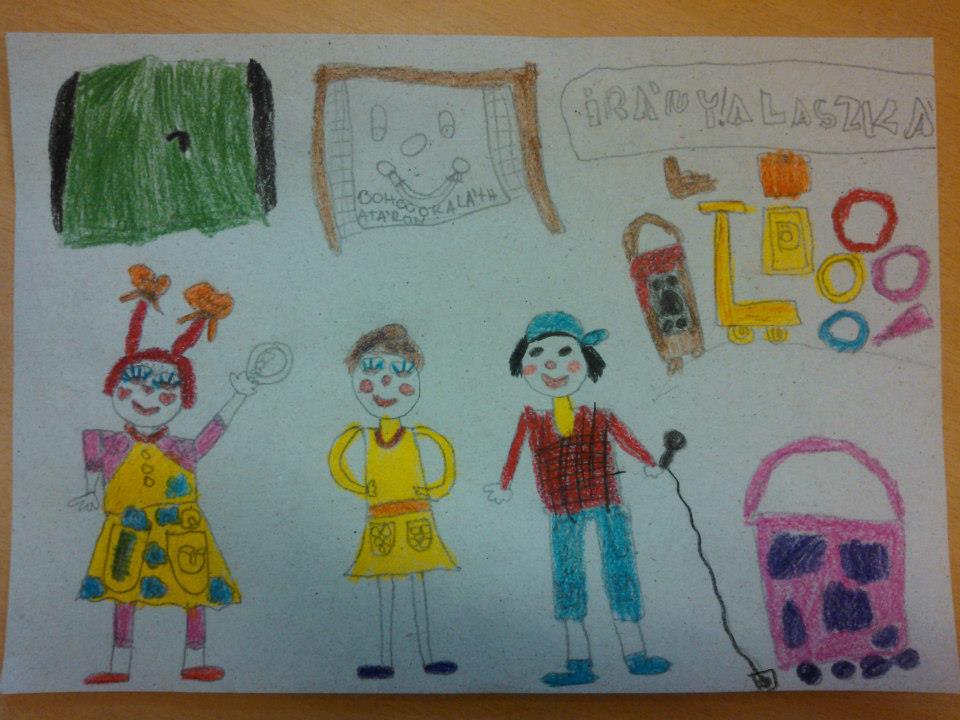
We usually go to the poorest parts of the country. In Hungary, two third of the poorest (officially: “accumulatively unprivileged”) children are Roma. So where we go, there are usually a lot of Roma kids, but Roma or not, they are deprived of a lot of possibilities other children – in other regions and with different backgrounds – benefit from. These children have very often never seen a theater show, a clown or any cultural event. Most children are very warm and loving and are obviously in need of affection and attention. After the show is over we always do a dance together with the kids; we often make circles and every child can offer a move that we all copy, if we can. They love it and it may continue quite a while at times. Another thing is that they just want to stay and talk to us. The girls usually go to the actresses and the boys go to our male actor. The little ones go to anyone. Two out of our five actors are Roma, one actress is half-Roma. The biggest star of the first two shows is Tamás, who is Roma and plays a gentle but strong, idealistic male character. The boys love him to death. They gather around him after the show, and it has happened a couple of times that they spring up during the show and hug him so tight that before we know it Tamás is on the floor with fifty boys on top of him! Generally, the children do not want us to leave after the show and they ask us to come back the next day. They sometimes send us poems and beautiful drawings.
Tamás is obviously a potential role model for the young men we encounter. We experience the same in the drama camp every summer. Our boys (now 13-14 years) have a strong need to talk to someone who is like them, is from where they are, and comes back to be with them, teach them, entertain them, etc. Of course, they also are happy to connect to the rest of us, but the boys clearly need Tamás the most.
In Ózd, when we ask the children at the end of each day what they enjoyed the most during that day, they always answer that the rehearsals, the part of the day when they get to come up with their own ideas, use their imagination or acting skills. They love that-even those children who are otherwise shy. On the other hand, when we talk to directors and teachers in the schools year around they almost always complain about the same thing: children are unmotivated. Why learn anything, if there are no jobs available in town? Unemployment is rocketing high, and there are generations who grow up without seeing their parents work. Because there is NO WORK AVAILABLE. Teachers say not even 10-15 years ago kids used to know what they wanted to be when they grow up; now they have no answers at all, or, they want to be celebrities, rappers or sports starts. All they want is to get famous and to get rich. On the level of reality they are clueless. Knowledge and learning have lost their value. Teachers unanimously complain about the education system and the lack of money. No money for cultural programs, no money for sports, no money for even the ink or the paper in the printer. And they are exhausted and overwhelmed. (My personal impression is that more and more kids fall out of this current system, more and more kids finish school without really learning to read and the system can offer almost nothing to those who do not fit in immediately for whatever reason. I must say, though, that the so-called IPR schools (Integrated Pedagogical System) are a great exception to this. IPR schools are without question the best functioning schools in Hungary.
Another thing that we see in the villages and small towns is in-your-face, straight out poverty. What this means is: children often going hungry, often not having any room or possibility at home to focus on school work, often lacking basic clothing for regularly going to school, poor immune system and frequent diseases, lack of daily routine in parents’ lives, lack of stability, lack of self-esteem, lack of encouragement – not always, of course, but too often, unfortunately. Children, therefore, may easily grow up in an environment that lacks any positive stimulus. It means they are very grateful for whatever mental, emotional, human or creative stimuli and attention they get. And this is our chance: to make them experience their own inner creative abilities, their own strong points, their inner and innate talent. With drama pedagogy, social theater, child psychodrama, theater in education – whatever we can do, we should do. I am encouraging everyone who might be hesitating if it is a worthwhile endeavor!
We, Clowns on the Horizon are looking at the horizon and are fantasizing about possibilities of a partnership with other professional Central or Eastern European theater companies who are interested in working for or with unprivileged children and youth. If you might be fantasizing about something similar when you look at the horizon, then please contact us at www.clownsonthehorizon.com.