


Interview with Alice Monica Marinescu, Katia Pascariu, Alexandru Potocean and Andrei Serban
UnderGround. The Jiu Valley after 1989 is a project of observation and analysis of the everyday lives of several communities affected by the political and social changes which began in the 1990s. The project aims to document the economic status, the lives and work of the miners in Post-Socialism. UnderGround is a project of performative reconstruction of the stories which fuel the history of the Jiu Valley communities, communities which find themselves on the border of survival, migration, extinction and possible reconstruction. The performance is based on research undertaken in the Jiu Valley and coordinated by Mihaela Michailov (playwright), Vlad Petri (photographer) and David Schwartz (director). The cast is made up of Alice Monica Marinescu, Katia Pascariu, Alexandru Potocean and Andrei Serban. The research was manifold: workshops, informal talks and interviews with miners, miners’ wives, pensioners, children, mine security guards, union leaders and people who make a living out of stealing coal.
Where were you on tour with UnderGround in 2012?
Alexandru: We went on tour twice, once during the summer and again in autumn. The first tour was in the Jiu Valley, in almost all the mining colonies: Petrila, Aninoasa, Vulcan, Lupeni, Uricani. After that, we went to Hunedoara, Brad, Deva, Baru Mare and Hațeg. Finally, we went to Maramureș County, in Tăuții Măgherăuș, Baia Sprie, Baia Mare and Cavnic.
How did you create an audience in these areas? Did the local authorities help in any way?
Monica: In Petrila, I felt we were receiving some support, but that was because David Schwartz and Mihaela Michailov had been there for longer and got to know many of them. But there were also areas were I felt like a complete stranger. We had problems in Deva and Petroșani, especially with the state theaters, the most reluctant of all institutions.
Katia: On the days when we were scheduled to perform, the theater managers chose to rent out the venues for other events in order to make some money. And even if you organize everything to the last detail, promoting the performance doesn’t go as smoothly as it does in Bucharest. In the Jiu Valley, people are skeptical, they need a lot of information, you have to explain everything very clearly and they don’t trust strangers very much.
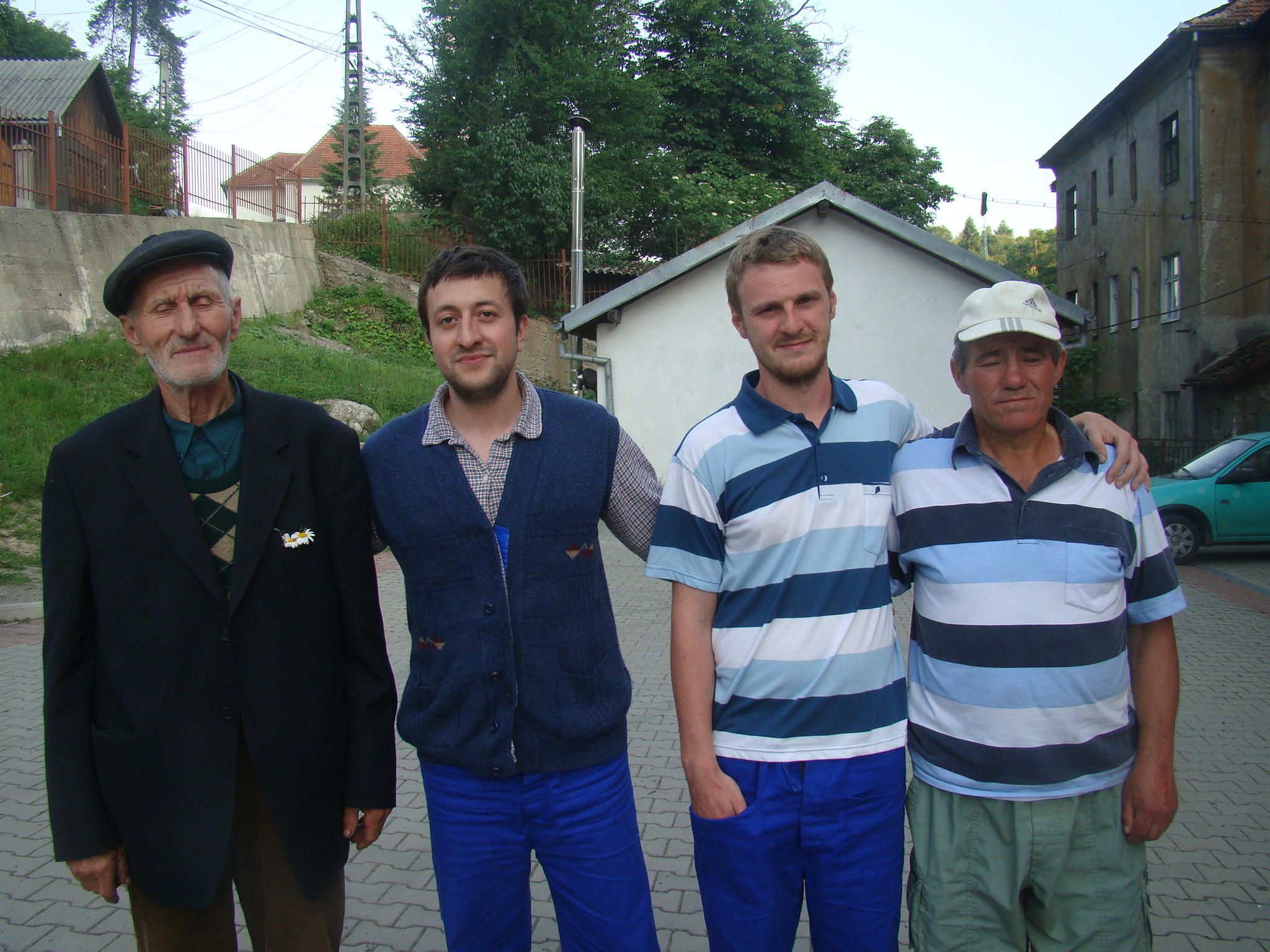
Alex Potocean, Andrei Șerban, Vasile Codrea (retired miner), Vasile Pantelimon (retired miner).
Aninoasa, 2012. Photo: David Schwartz
Did you feel there was a big difference between the audience over there and the audience in Bucharest, to which you are more accustomed? I mean differences in their reactions to what was happening on stage.
Andrei: Definitely. Already after the first show, we noticed the audience reacted during the event, they made additions to the text, they recognised the people and talked out loud. The fact that they recognised the stories enticed them, it made them want to get in on the storytelling. There was no boundary between the stage and the audience, to them it was an open conversation, not a theater performance. […]
Some of them had come to the theater for the first time, right?
Andrei: That’s right. In some of these towns, there have been no such events since before 1989.
Alexandru: It was totally unpredictable. Like in Vulcan, for instance. A gentleman who didn’t know what was going on entered the theater. He interrupted me during the monologue and asked me to sing. Stuff like this can be a bit uncomfortable, but you have to handle it somehow. You can’t tell that person to be quiet. You have to integrate him in the performance, make him understand what’s going on.
[…]
Katia: Not to mention the post-performance discussions, which are always interesting. Sometimes, these discussions touched on the socio-political situation in Romania and people talked about their professional and personal experiences. There are several levels here. The research and the interviews are the first level, the performance is the second one and the post-performance discussions the third.
Do you think the people felt well represented by the way in which you approach their social and economic issues in the performance?
Andrei: At first, they were very skeptical. We were handing out fliers and I was asked: “Where are you from?”, and when they heard we were from Bucharest, they asked “What do you know about the Jiu Valley? Do you know how we live down in the mines? Have you ever been down there?” And then we would tell them that we did go down in the mines, we did talk to people and so they became more trusting and realized our research wasn’t a superficial one.
Katia: And our performance didn’t involve only miners, because everyone thinks only of miners when they hear of the Jiu Valley. We also talked about women, children, the elderly. And this was something very well received. […]
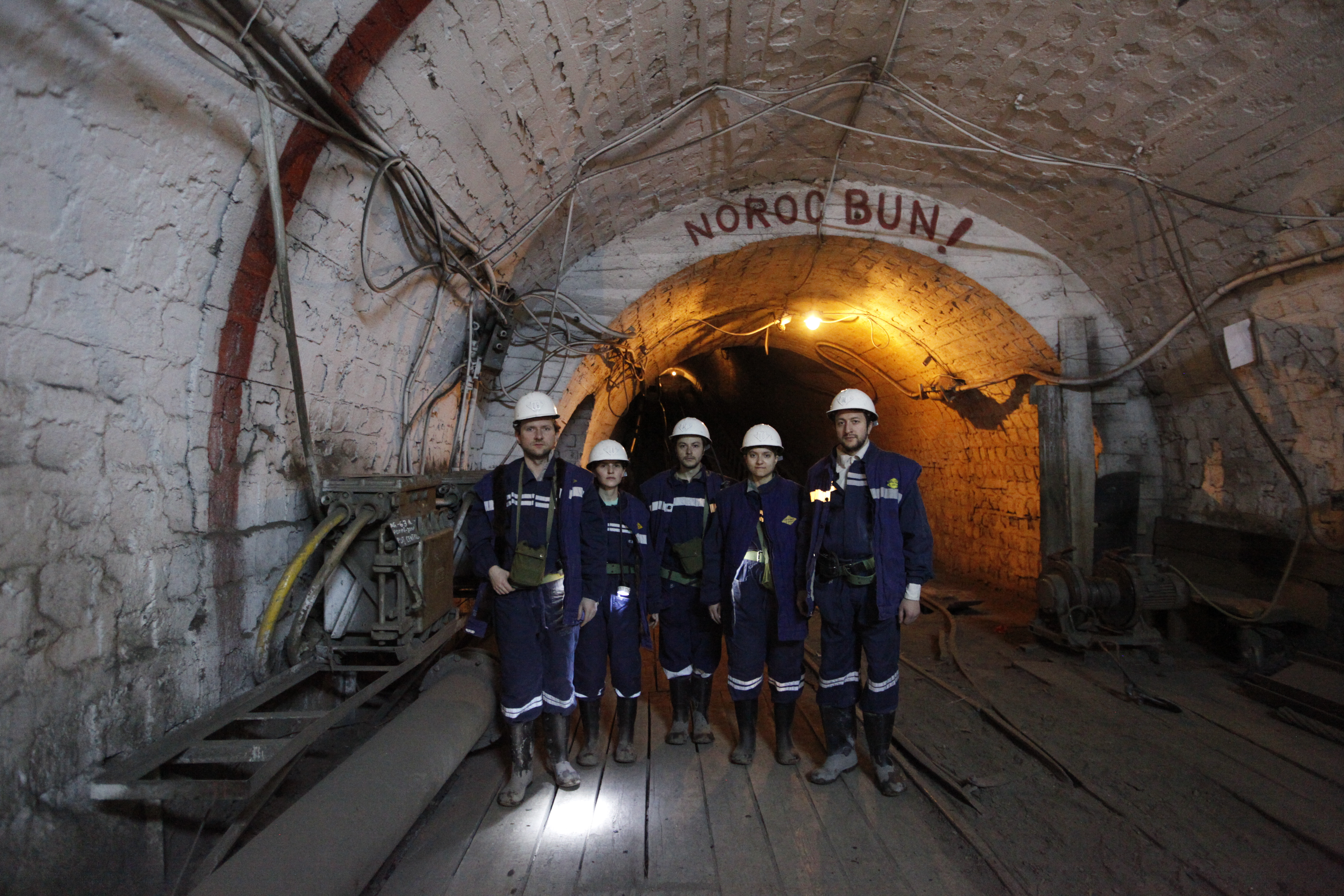
Part of the UnderGround team at the entrance to Petrila mine. Photo: Vlad Petri, 2012.
Tell us a bit about the people whose stories you perform.
Katia: I play a 90-year-old lady who was a well-known seamstress in Petrila, and who later turned to making wreaths. She talks about what it’s like to be a miner’s wife and about the customs and traditions of the Jiu Valley.
Andrei: The first person I perform is a gentleman who left from Northern Moldova in 1990. He left because the wages were very high in the Jiu Valley at the time and he also managed to bring his brother with him. In 1997, when people were laid off, many of the miners accepted the severance pay. His brother was one of them. The money he got didn’t get him very far, so he had to return to the countryside, in Moldova, where he couldn’t find any work. But this gentleman stayed in the Jiu Valley and is one of the fortunate ones. He managed to save money, but sacrificed a lot in the process. He saved enough to build a house for his son, but even he admits he sees no future for him there.
[…]
Alexandru: The first person I play is a retired miner from Aninoasa who used to work for the mining rescue unit. Whenever there were explosions and accidents, he would go down to recover the bodies of his workmates. He talks about some gruesome events. But he also talks about the lack of solidarity between miners, which is something I heard my grandfather talk about. There were people from very different environments and of different ethnicities who came to work in the mines and they didn’t always get along. The other person is a young man from Petrila who was a security guard at the mine at that time. He had to guard the scrap-iron which is for many people the main source of income. People steal the iron and sell it. He talks about his schedule and you can see a young man’s perspective on the Jiu Valley. He worked 12 hours every 24 hours and made 350 lei a month (roughly 80 euro) in 2011.
Monica: I tell the story of a 37-year-old woman who lives in the Bosnia neighborhood in Petroșani, in former miners’ houses which are now derelict. 90% of the people there are poor Roma, living with no running water and no electricity. This lady went to prison after she was caught “stealing” scrap-iron. She had two children, but they both passed away. It’s a truly dramatic life story which we watered down in the performance. This way, you understand the perspective of those who have to steal for lack of any other alternatives.
Together with Katia, I also tell the somehow “successful” story of a miner’s wife. She is a lady who had several jobs and then opened a small business in Petrila, a fast-food. She talks about how she handles her responsibilities as a boss and what it’s like to be a miner’s wife. […]
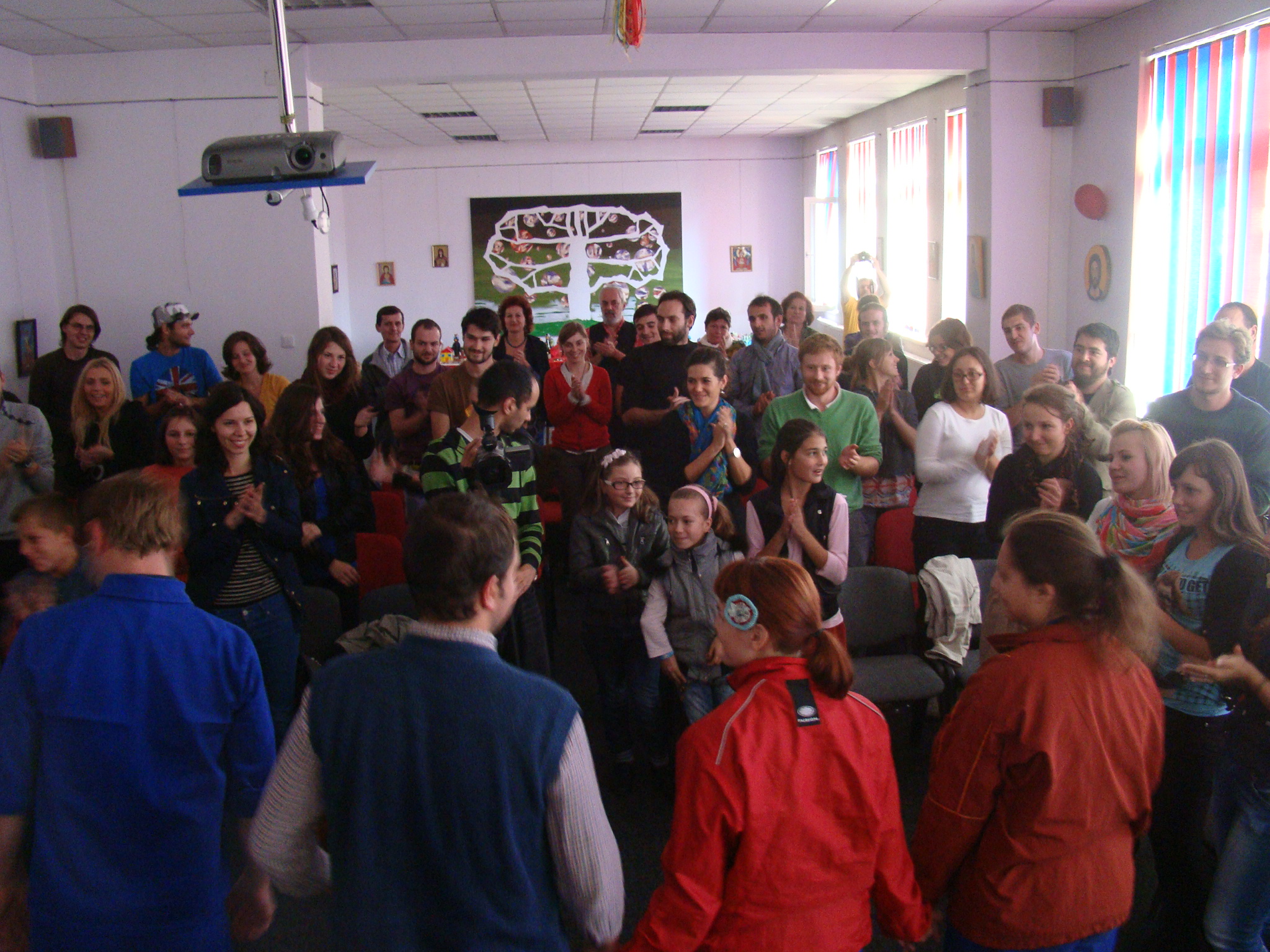
A performance in Petrila, 2012.
Some of the people whose stories you performed came to see the show. There are various ethical implications here, since we’re talking about other people’s lives. How would you describe the experience?
Andrei: It was very emotional for me. I couldn’t wait to perform, because I knew “my character” would be there. And I thought I would pick him up from home. He was eager to see himself performed. I went to his house and started singing one of the songs from the performance. We spent an hour together before the show, and I tried to understand what kind of person he was. It’s interesting he didn’t see me as a stranger. He acted as if we’d known each other for a lifetime. After I started my monologue, he stood up, raised his hand and said “That’s me!” And he was standing right in front me. It was very touching. He recognized his story and wanted to add some more information. I felt the text was being written then and there and we were writing it together. Sometimes he approved: “That’s right!” It is, indeed, a huge responsibility, especially since there was a significant age gap and there was the risk of creating a caricature. It was then that I understood my stake as an actor. It‘s not just about me, it’s also about the other. […]
Interview conducted by Ionuț Sociu and Marius Bogdan Tudor
0 comment
Acest spectacol a avut loc pe scena Teatrului Dramatic Ion D.Sirbu-Petrosani fara sa fie perceputa nici o suma de bani.Sunt convinsa ca dintr-o eroare s-au facut anumite afirmatii.Nicoleta Bolca-manager general Teatrul Dramatic Ion D.Sirbu
Cu tot respectul, doamnă Nicoleta Bolca, vă reamintesc că după luni de zile de discuții în ce privește programarea spectacolului Sub Pământ la Teatrul I.D.Sârbu din Petroșani, deși stabilisem cu mult înainte data reprezentației, deoarece aveam în fiecare zi spectacole în celelalte orașe din Valea Jiului, ne-ați spus că trebuie să schimbăm data pentru că aveați altceva la teatru. După ce am schimbat-o, cu o seară înaintea spectacolului, mi-ați telefonat și mi-ați spus că nu mai putem juca la ora stabilită, ci mai devreme, adică la ora 17.00, pentru că aveați un concert de muzică populară și de dansuri în holul teatrului. Am început la ora 17.00, nu aveam ce face, concertul a început mai târziu – inutil să vă spun că eu și colegul meu David Schwartz am stat permanent de vorbă cu oamenii din ansamblul folcloric, enervați pe drept, să le explicăm și să-i rugăm să amâne puțin începerea spectacolului. Artiștii din ansamblu au fost înțelegători și au amânat cât au putut începerea spectacolului lor, iar spectacolul nostru s-a derulat, cam 45 de minute, în acorduri de muzică populară. Eu cataloghez această atitudine ca o bătaie de joc, nu numai față de artiști, ci și față de publicurile ambelor spectacole. Nu ne-ați cerut bani, în schimb m-ați întrebat de nu știu câte ori de unde ne vin banii, câți bani avem etc., deși vă spusesem și la prima noastră întâlnire, atunci când eu și David Schwartz am fost în documentare. Erau de la AFCN, o sumă derizorie în raport cu bugetul teatrului pentru un spectacol. Numai bine și succes în toate! Mihaela Michailov
Foarte interesantă experienţă.Prin noutate şi amestec, prin complexitatea trăirilor.Prin ecou.In primul rând,am avut impresia că aceasta va fi modul prin care se scrie istoria. Asta insemnînd credibilitate. Lucru mare, dacă te gândeşti in urmă,că trebuia invăţat ce spuneau unii, fără a avea incredere că nu înveţi să ştii un text literar…ficţiune;mi-am pierdut increderea in istorii, istorici, istorie. De aceea circumspect, doresc să văd modul in care se relatează adevărurile trăite de mine. Şi când dau de ele, de fapt mă impresionează nu adevărul neapărat,o faţetă, ci modul, mijlocul de exprimare, modul in care se face apel la intuiţie,senzaţie…Nu am văzut nici un spectacol de teatru care să mă pregătească pentru o nouă abordare, un nou stil, cunoscând in general ceea ce înseamnă *teatrul*,ca orice privitor,din moment ce se întâmplă pe scenă şi e jucat/interpretat de actori…ori citind teatru,cu interpretarea şi regia din mintea mea.Ficţiune ori regăsire.Foarte ciudat, să vezi jucându-se personaje şi tu din scaun să-i recunoşti. Cu amănunte, cu detalii, care-i leagă inconfundabil de ei.Si amănunte care m-au impresionat la maxim,dungile de pe tricouri.În oglindă.Nimic întâmplător.Nu aş termina cu laudele şi cei implicaţi s-ar simţi jenaţi, deoarece ei caută amănuntele imperfecte pentru a le perfecţiona. Ori eu, nu sunt in stare să le dau.Modul simplu de a face scena să vorbească, tabla scrisă, umeraşele, muzica, toate au punctat lucrurile esenţiale. Austeritatea,umorul,ori drama. Faptul că fiind monolog, in cea mai mare parte,se elimina plictisul,nu ştiu cum.De ce mi se părea interesant şi doream să ascult lucruri cunoscute.Nu ştiu de ce. Cum poate ceva simplu, cunoscut, neinteresant la prima vedere să capteze atenţia.Să înveţi să redai povestiri,care spuse nu-s poveşti ci rămân in sfera adevărului.Ce-i aşa interesant. Şi totuşi.Nu-i surpriza de a vedea furnica banală ca fiind un personaj.Sau poate chiar asta este.Că fiecare în banalitatea, cenuşiul, infinitul istoriei,in toată ţesătura ei, contează.Si înainte poate de a conştientiza asta,şi-ţi spui că-i neimportant, vezi,şi ţi se schimbă percepţia.Rolul pe care-l joci e pe scenă.Nu-i glumă, chiar ai un rol pe scena vieţii.Rămân încă, cu sentimente amestecate,senzaţii ciudate, de la inedit la cunoscut, fără a mi le putea explica pe toate.Impresionată până la lacrimi, căci iată şi acum, după atâta timp…Ori depinde de cât este de sensibil spectatorul. Dar cred, poate fi sensibilizat.Dar ştiu că este extrem de important ceea ce faceţi. Mesaj, aducere în prim-plan a trăirilor unor oameni,mase,care clar,pentru unii sunt inexistenţi.O alternativă ar fi să vedem dacă nu avem sufletele impietrite faţă de parlamentari. Ce ar reuşi să ne impresioneze la ei. Care parte din omenie le-a rămas intactă.Nu, nu-i o glumă nici o sugestie. Întrebarea ar fi cum ar percepe ei, acest gen de comunicare. Cu drag şi dor, Cristina.
Dragă Cristina, mulțumim mult pentru aprecieri și împărtășirea experienței de spectatoare și desigur coautoare a demersului nostru. Cât despre parlamentari, din păcate cred că sunt ceva mai greu de impresionat decât noi. Cele bune, cu drag, dor și speranța că ne revedem curând! David