


by Simina Guga
Born in the Wrong Place
By: Alice Monica Marinescu and David Schwartz
Cast: Alexandru Fifea, Katia Pascariu, Mihaela Rădescu, Andrei Șerban, Silviana Vișan
Scenography: Adrian Cristea
Music: Cătălin Rulea
Special thanks: Bashar Al-Kishawi, Margareta Eschenazy, Valentina Ivanov, Ahmad Marwi, Sana Rahimo, Simina Guga
The performance Born in the Wrong Place is based on the documentary theater text written by Alice Monica Marinescu and David Schwartz in 2011 using the verbatim method. The text intertwines the life stories of 5 people who have gone through the experience of seeking asylum with fragments from The Guide to Obtaining Romanian Citizenship for Foreign Citizens.
The performance creates a favorable context for getting to know and understand the dynamics of migration and asylum, and the status of refugees and migrants in general. The performance aims to problematize and discuss in the public sphere issues which are of crucial importance in the current global context, issues such as the institutional fight against migration taking place at the same time as the need for migrants in the development of the capitalist economy grows, the need for asylum, the right to travel as the fundamental right of every individual and the instrumentalization of “the foreigner” as a scapegoat for social and economic issues.
“Exile is strangely compelling to think about, but terrible to experience. It is the unhealable rift force between a human being and a native place, between the self and its true home: its essential sadness can never be surmounted. And while it is true that literature and history contain heroic, romantic, glorious, even triumphant episodes in an exile’s life, these are no more than efforts meant to overcome the crippling sorrow of estrangement. The achievements of exile are permanently undermined by the loss of something left behind forever.” (Edward Said, Reflections on Exile)
People used to be hopeful about the future, believing that modernity will bring progress and development. But “the future” brought with it more warfare, more divisiveness, more technology and less solidarity, replacing human interactions with the bureaucracy of hierarchical systems. Few people believe they were born in the right place and the age we live in is one of uprooted peoples, massive migration and human tragedy. People have tested their limits by creating destructive mechanisms, be they military, conceptual or symbolic: guns and armies, propaganda, racism, xenophobia, ethnic divisions, borders of all sorts and, last but not least, nation-states – an umbrella for all these manifestations of “civilization.” Migrants are the implicit result of this context, a vague concept attempting to define an inaccurate reality and contain an entity which is unmeasurable, a group which everyone has been part of or can be part of at a certain point in their lives.
The performance Born in the Wrong Place took shape in the minds of its authors, Alice Monica Marinescu and David Schwartz, after a meeting with an Afghan migrant during a trip to Central Asia. Several months later, he was represented as Jamal, a young man dreaming of a better world who was still searching for a different life, going through his fourth experience as a migrant: Iran, Afghanistan, Germany and Uzbekistan. The other characters are Estera – an old Jewish refugee during World War 2, Sonia – a refugee from former Yugoslavia, Selim – a Palestinian man from Gaza, born in Kuwait and granted asylum in Romania, and Samira – a Christian woman from Iraq, seeking asylum in Romania shortly after the country was invaded by US troops.
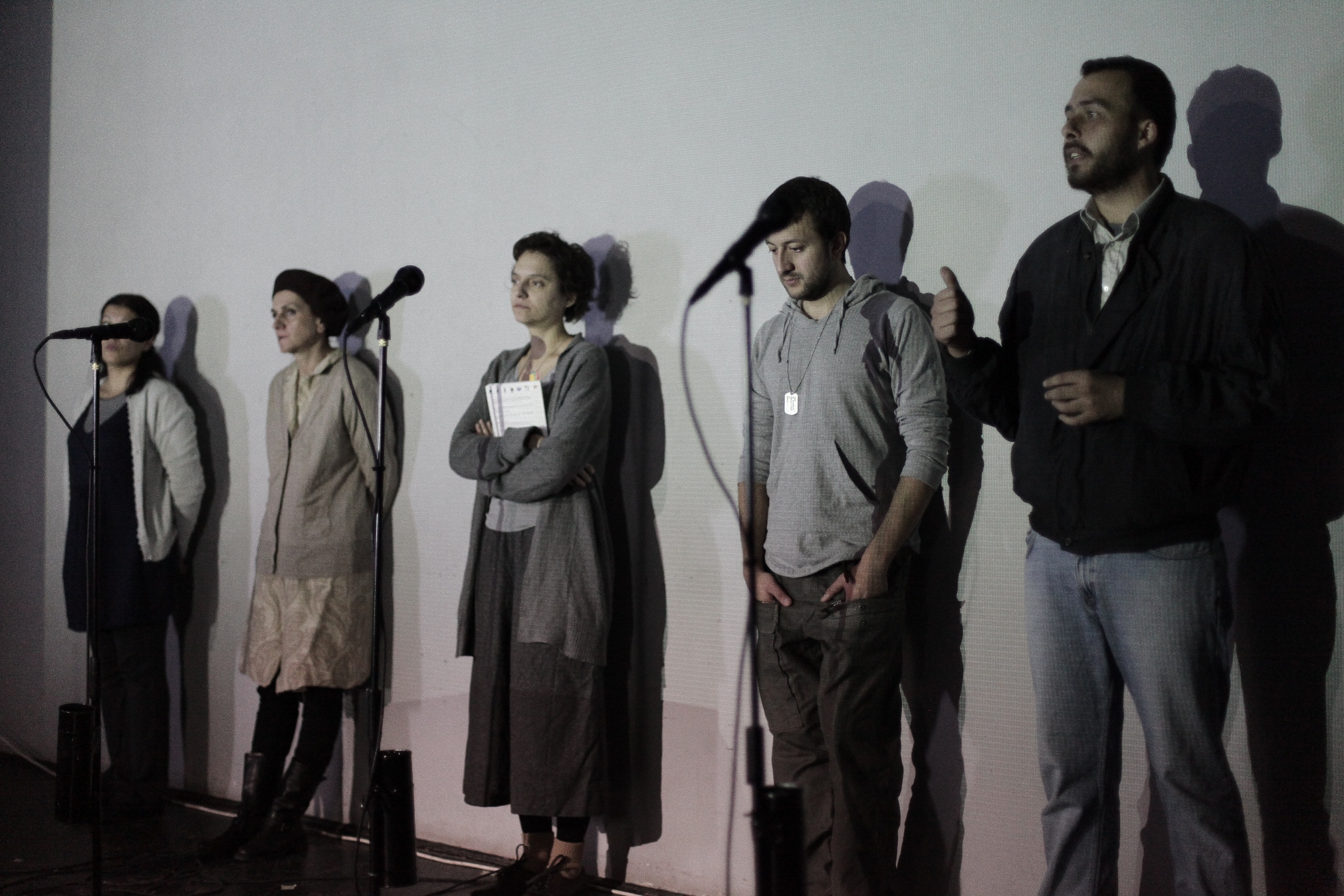
Born in the Wrong Place, 2013. Photo: Monica Marinescu.
The stories of the five characters intertwine throughout the performance, reflecting the dramas and dilemmas of the migrants concerning belonging, negotiating identities, nationalism, institutional bureaucracy, distant people, loneliness, inability to adjust to an unjust context etc.
“In Iraq there is war, no home, no mother, no father, better dead here than dead there. I ask asylum. I refugee since 2006. Receive passport A category, blue passport. A category – international protection, B category – protection only Romania. I refugee have the same right as European citizen. Only I cannot votes. I never go back to Iraq. War destroy everything there. Nothing remaining of Iraq!”
European directives aim to offer equal rights to EU citizens, their family members and persons benefitting from a form of protection. But reality is never reflected in the directives, and neither are the directives a mirror of everyday life. Poorer states of the EU – Romania being one of them – offer refugees the right to live in the country, to work, to study and to settle down with their families, but fail to support them in achieving these rights. As soon as they receive a form of protection, they are on their own in a poor society, where people speak a different language and are not taught to understand their situation. They have to find a home, pay rent, get a job, learn the language, obey the law and feel privileged that they have received “a form of protection” from a European state. How they manage all this is entirely their business, since protection is “humanitarian”, not economic. Refugees seem to be the last concern of a stat which forced millions of its citizens to find opportunities of subsistence outside its borders. This is why many refugees leave or dream of leaving for Western Europe, for those countries where they can start over: Iraqi citizens, refugees in Romania, working in Germany, Sweden, France, England… The experience of exile is thus reproduced, “home” is nowhere to be found and rights exist only as a prerogative of modern bureaucracies which refuse to offer them in conjunction with real opportunities.
“People would make fun of you if you were from Afghanistan. All kinds of stupid jokes – ‘Afghans are dumb!’, ‘They’re all workers!’, ‘They’re stuck in the past, they’ve been living the same way for 1000 years!’ And the stupidest thing – when an Iranian child cries or misbehaves, the mother scares him/her by saying: ‘If you keep crying, I’ll send you to the Afghans to have you for lunch!’ Har har, very funny. During my senior year in high-school, I couldn’t wait to enroll for university. On the third day of school, the principal came to our classroom and called out my name. ‘Jamal, get your backpack and come to my office.’ Another big NO! followed. I started going from one office to another with my mom, begging them to let me go to university. It was no use. Afghans were not allowed to go to university. Other foreigners were, but not Afghan refugees. That was the new law.” […]