


by Panna Adorjáni
Can the theater be for everyone? And if it can, how exactly can it do that? Does subsidized theater have the ability to attract everyone? The fact that young people are no longer interested in the theater or that there are no performances for children, the fact that the theater is too elitist or that the level of the artworks is on a downward spiral – all these otherwise burning issues have become as many clichés used by applicants to various management positions, who promise that all these issues will be solved once and for all. Undisputedly, even in revolutionary fashion – if possible, even in one performance. Joking aside, if we take a closer look at the theater, we see that it neglects certain social categories: employees of multinational corporations, industrial workers, pensioners or marginalized groups such as people from the countryside, Roma communities etc.
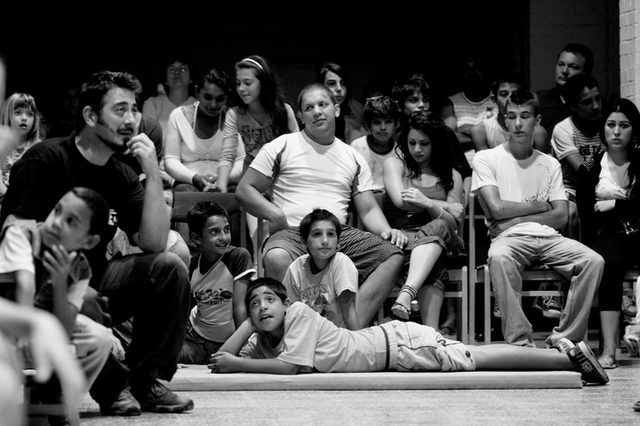
The New Spectator
In Hungary there are several theater groups which deal with one of the above-mentioned communities. “Káva – Cultural Workshop (Káva Kulturális Műhely)” has been doing projects of education through theater for 18 years. Their performances are aimed at small groups (a class of 14-15 year-olds, for instance) and follow the guidelines of the Theater in Education (TIE) programs. This group was the initiator of The New Spectator (Új néző) project in 2010, together with the Association for Culture and Social Sciences “anblokk” and Krétakör, an independent group from Budapest, founded by Árpád Schilling in 1995, which later became one of the most important centers of Hungarian theater. This collective stopped producing traditional performances in 2008 and became a center of contemporary art, as well as an agency of theater productions which “develops creative social games using expertise from the social sciences.”
[…]
In an interview to Magyar Narancs, Gábor Takács referred to a TV show in post-apartheid South Africa as the inspiration for the program. That show was made up of a series of discussions between a white person and a black person which took place in an amphitheater. The program was on for several years and its beneficial effects were scientifically tested. In the case of The New Spectator – an experiment which can be assessed as similar to that of the South African one – the organizers chose two villages in which the presence of ethic Roma was somehow representative. The ethnic divide in these two villages is different: in Szomolya, a village of 1700, there is a Roma minority of 10-15% who are segregated and discriminated against by the ethnic Hungarians, whereas in Ároktő, the village with 1200 inhabitants, 50% are Roma and are a part of the life of the community. Despite appearances, the ethnic tension is much more present in Szomolya, where the social processes after 1989 led to an obvious rift in the community (the settling of the Roma is seen by the ethnic Hungarians as a “Gypsyfication” (țiganizare) of the village). This is why the two experiments have developed in different ways: while in Ároktő the project is accepted by the community and supported by the local authorities, in Szomolya it has very little support and The New Spectator seems to be a Roma-only event. It’s no wonder, then, that the program is mostly taken up by them and instead of six meetings a week, there are only three […]

The New Spectator
The New Spectator introduces a couple of newlyweds who are confronted by issues such as “what’s more important: the house or the car?”, “to what extent should you help out family members?”, “is it a bad thing to say ‘enough is enough’ and kick the relatives out at some point?”. Another exercise – improvised by the young volunteers from Szomolya – depicts a typical situation: an ethnic Hungarian man and a Roma woman fall in love. How will the families and the village react? Can love defeat prejudice and racism? In an interview with one of the participants, a girl explained why an ethnic Hungarian and an ethnic Roma could never be together: “It’s a dream, but it’s not possible. Racism is gaining more ground. Actually, I don’t know if it’s the racism in them or simply peer pressure, the fear of thinking in a different way.”
[…]