


Erwin Piscator (1893-1966), theatre director and political theoretician, initiator of the political theatre. In Berlin, Piscator founded the Proletarian Theatre (1920), Central theatre (1924) and Piscator Bühne (1927-1929). In 1934, he emigrated to the U.S.S.R. , then to France and United States. He returned to Germany after the second world war and was in charge of Freie Volksbühne (1962-1966).
Naturalism and the people’s stage are the underlying principles of the proletarian theatre theorized by Erwin Piscator in his work, Political Theatre.
The establishment of the Volksbühne theatre constituted a radical rupture with the bourgeois theatre which emphasized aestheticism, grandeur in art and the transcendence of the realities of everyday life. The Volksbühne set as its goal the staging of good performances for good prices while also aiming at cultivating its audience. But adopting the slogan “Art for the People” did not mean fully abandoning the bourgeois ideals. Piscator’s vision, however, entailed a fundamentally proletarian theatre, a type of theatre that would not just be a means of culturalization, but conscious propaganda. For him, it was essential for the theatre to act politically: to go into neighborhoods, in culture houses, meeting points – wherever the proletariat gathered to discuss their issues. This is why Piscator chose not to employ professional actors, but workers who could understand proletarian theatre as an essential part of their lives: “I considered it a necessity to work with people who, just like me, saw the revolutionary movement as the driving force, the engine of their creation. To me, the whole idea behind the proletarian theatre revolved around the building of a community that would be human and artistic, but also political.” Along with the media or the parliament, proletarian theatre became a fundamental means of expression of the revolutionary movement.
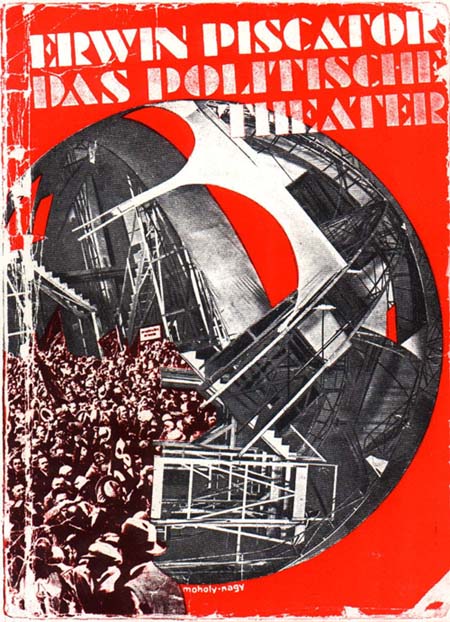
Erwin Piscator – Das Politische Theater