


by Jan Cohen-Cruz[1]
The very act of speaking one’s story publicly is a move toward subjecthood, toward agency, with political implications.
The story circle is one of the most pervasive forms of workshopping and playbuilding in community-based performance. Although there are many variations, circles typically involve from five to twenty-five people who choose a theme and then, one by one, tell a tale. Each story is welcome no matter what its style. In accordance with the Appalachia-based Roadside Theater for example, stories might recount family history, local history, folklore, ghost lore, a personal experience, or even riddles or jokes passed down through the generations. Participants in story circles typically focus on listening to the other stories and they then decide what to tell in response to what they have heard. Telling personal stories in this sense is a way to have a public conversation, to be in relationship to others. Such stories do not necessarily address oppression; they are as likely to be about cultural celebration and individual affirmation.
Stories of both celebration and oppression move toward the political but differently. Telling stories of cultural celebration is a way that members of marginalized groups express their own values and is an example of assets-based community organizing, emphasizing a group’s strengths. To the degree that the teller has a strong sense of identity with an under- or misrepresented culture, the story is personal and political; attention to the story is attention to that culture as represented from within. Such stories often serve as counter-histories which make public points of view that were previously “hidden from history” (Rowbotham, cited in Perks and Thomson 1998: ix). Through stories that emphasize oppression, people see such occurrences as struggles in social context rather than as personal limitations: the larger inequities that underlie their personal experiences rise to the surface. Stories in TO (Theater of the Oppressed) are unresolved, because that is the opening through which spect-actors intervene with potential solutions. Participants find others with experiences of the same oppression and are both affirmed in the reality of their struggle and joined with potential allies to fight against it.
Storytelling literally makes knowledge through group interaction around hitherto private experiences. Such was the role of personal storytelling in the context of grass-roots consciousness-raising (CR) groups, one of the seminal processes of the 1970s’ women’s movement. In my own experience, a group of six or seven women would meet every two weeks in one of our apartments and talk about gender concerns from our everyday lives. We told personal stories to unearth their political implications. We’d hesitate; it seemed so petty to talk about our little relationships. But like women telling such stories in kitchens all across the country, we were discovering that many of our personal peeves were in fact socially structured to keep women in their place. Such knowledge emboldened us to change our everyday arrangements.
[…]
Collective identification with personal story
In Forum Theatre, when the story is enacted, it is no longer just that person’s tale. Each person’s story is but the raw material from which the scene, with which everyone in the group must identify, is created. In testimony about social oppressions, the teller is speaking on behalf of not just himself but a whole class of people struggling against similar unjust treatment. Under what conditions are people with no social cachet individually not only listened to but treated as catalysts, their experience deemed important, and their authority to speak for a group recognized?
As Shoshana Felman writes, to testify is “to produce one’s own speech as material evidence for truth—to accomplish a speech act rather than formulate a statement” (1992: 5). Testimony in a legal context refers to serious statements made under oath that may hold life and death consequences; the term also means a public declaration of religious experience. In both cases, testimony contains the notion of answering to a higher power, be it the nation state in whose realm the court is situated or the spiritual force in whose realm institutions of faith are located. One puts one’s hand on the Bible and swears to tell the whole truth. The act of giving testimony unites the teller with the listeners by evoking shared values. The context of an institution whose authority is accepted renders the individual’s voice within that context authoritative as well.
Political action and personal therapy are intertwined in testimony, given its “double function” of “producing social discourse and initiating individual recovery” (Miller and Tougaw 2002: 13). There is, however, a danger of relegating the individual to a secondary position in the interest of furthering the social goal. Orly Lubin describes an example of imbalance between the value for the individual and for the collective in the uses of the testimony of Zivia Lubetkin.
One of the leaders of the Warsaw ghetto uprising of April 1943, Lubetkin immigrated to Palestine and gave her testimony twice. The first time she told her story privately to two Zionist leaders, one of whom writes: “She told us—in tears, with pauses, in Yiddish, in Hebrew, in silences—what was in her heart. The story was unimaginably tragic. There was nothing in it of heroism, no glory, but it was as if she herself was bearing the entire six million” (Rabinowitz, cited in Lubin 2002: 133). The second time, two days later, she gave her testimony publicly: “Relinquishing the first-person grammatical form, she translated her personal experience into a collective narrative,” embodying the “new Jew” that fought Nazism and “thus answered a collective need” to know that some Jews did not go to their slaughter like sheep (Rabinowitz, cited in Lubin 2002: 133). Lubin analyzes the expanded role of the witnesses to Lubetkin’s testimony: “Lubetkin allows her listeners to do more than enable the testimony; she allows them to mold it, to determine its narrative form and its symbolic use. Making herself subservient to the group, she tells a story that they need to hear” (Lubin 2002: 134). Lubetkin’s personal trauma was resituated at an alarming speed, from her own experience to a collectively sustaining image. I wonder if and how such a radical reinterpretation of the story helped her through her own despair even as I can imagine relief at having the story be so meaningful to her new community.
Despite personal costs, the teller can absolutely galvanize a community that identifies with her. Such was the case of Rosa Parks, whose story was chosen by civil rights leaders to be the symbol of bus desegregation for a large, public audience. In December 1955, when Parks transgressed Jim Crow-era laws segregating people of color to the back of the bus, she was not the first. The previous March, “a feisty high school student named Claudette Colvin. . . defended her right to the seat in language that brought words of disapproval from passengers of both races” (Branch 1988: 120). In October, Mary Louise Smith likewise refused to give up her seat for a white woman. Yet civil rights leaders decided that Smith’s alcoholic father and substandard living conditions—“one of those see-through clapboard shacks”— made her “no better suited to stand at the rally point than was Claudette Colvin” (Branch 1988: 127). Parks, on the other hand, was considered so beyond reproach by people of color and whites alike that her personal story of injustice was selected for courtroom dramatization. The timing was so ripe that the Montgomery Bus Boycott was organized to protest her arrest. Parks’ story became the story through which the community organized and drew a line: no more arresting Negroes for not giving up their seats to white people in public buses. As the Reverend Martin Luther King Jr. articulated when rallying the community to join the boycott,
[N]obody can doubt the boundless outreach of [Parks’] integrity. Nobody can doubt the height of her character, nobody can doubt the depth of her Christian commitment . . . And you know, my friends, there comes a time when people get tired of being trampled over by the iron feet of oppression. (King, cited in Branch 1988: 138)
And yes, the crowd responded, yes, their voices rose up, yes.
A play, too, can resituate personal stories as the expression of a particular group. Boalexperienced such a dynamic with a play he staged in 1962. It was based on personal stories about a metal workers’ strike in Santo André and was written by one of the workers. At a performance in Santo André, the man on whom the villain was based protested vigorously, leading to interaction with other audience members upon whom other characters were based. What followed spontaneously anticipated Forum Theatre in the active audience involvement elicited: “The real people other characters were modeled upon got up on stage and each incarnated themselves in front of their actors, the scene fragmenting into explosive simultaneous dialogues with worker-models of characters pitted against actors and their characters” (Boal 2001: 203). In the ensuing mayhem, Boal tried to convince angry spectators that it was just a play, a fiction, not them. They would have none of Boal’s explanation, feeling grievously misrepresented. Finally they agreed that the actors could continue to speak the script but they would correct them as necessary. This performance intrigued Boal in its interaction of the image and the reality of the same character. He also recognized the dynamizing effect on the people on whom the play was based and the level of interaction precipitated when not just an individual but a whole community gets to see performed what they themselves presumably said or did.
This production also raises the issue of intimacy and distance—i.e., the degree of close-people who identify with it. While a play is always a representation, even when based on an actual event, such recognition is difficult for an audience watching a play of and about themselves, using their very words. For the Santo André audience, this play was their story. That intimacy caused a problematic but ultimately productive level of engagement, resituating the play at the intersection between an aesthetic event and a documentary of their very lives.
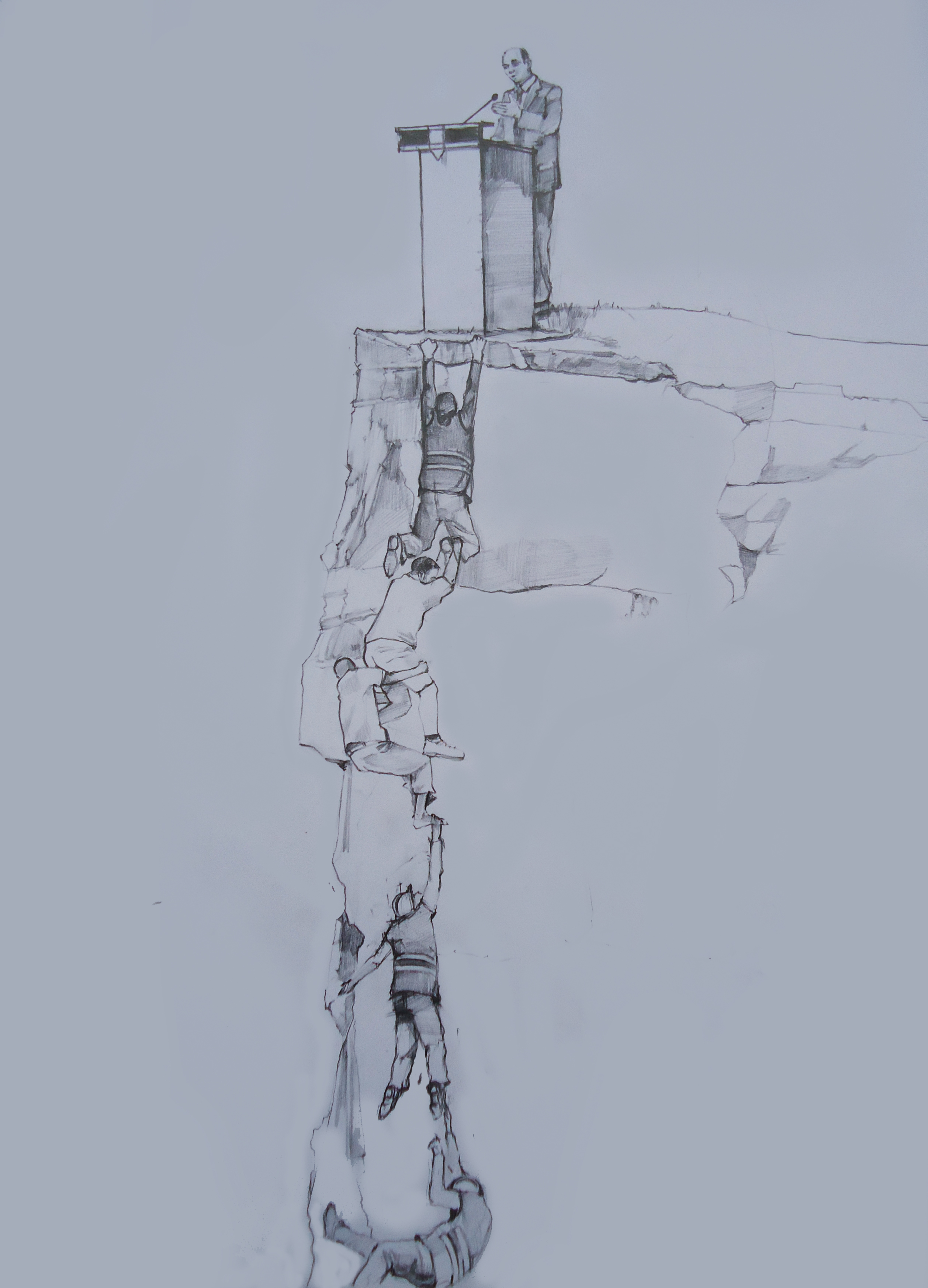
Laurențiu Ridichie. No title, 2012.
Critical storytelling in theatrical practice: O’Neal, Lacy, Boal
Not all storytelling is liberating. One might use personal stories to come to any conclusions. Personal story risks merely reproducing dominant ideology, as with a rape narrative through which the victim blames herself: “I shouldn’t have been there . . . The way I dressed was asking for it.” In this section, I discuss exemplary practices of three artists whose work with story does have a liberating component.
In 1963, artist/activist John O’Neal co-founded the Free Southern Theatre as a cultural wing of the civil rights movement that used stories to promote agency in people who were at once the least powerful and most affected. Rather than telling them what to do or think, the company’s performances were intended to stimulate post-show discussion. The exchange of stories proved a better way of having dialogue than argument because, explains O’Neal,
Adversarial debates reward people who are trained in their techniques. Those tend to be people who have the largest vocabularies and largest egos and most willingness to claim ground and hold it. Which merely affirms the problem you’re starting with in the first place. So instead of standing on stage and answering questions, I moved off the stage and sat in the audience and said, “Why don’t you tell me a story that the experience of the theatre evoked in you?” (O’Neal 2002)
In O’Neal’s current initiative, The Color Line, story gathering is part of an assets-based approach to dismantling racism. One artist, one educator, and one activist in each of several towns collaborate around the local legacy of civil rights. The artist gathers personal stories on the subject that are used in some way thereafter with the help of the educator and the activist. The idea is that people may have limited material resources but are rich in experience. The stories are vessels for what people have learned and what they find meaningful that can be translated into educational and activist projects.
Suzanne Lacy, who creates large scale, visually-compelling performances with nonactors about issues that concern them, is cautious in her use of personal story. While she weaves consciousness-raising processes into performative pieces, she finds that personal stories tend to distort perspective, especially when they do not move to a larger level:
Everyone operates within a personal narrative history and present that centralizes them within a very vast world. One of the problems with race relations today [Lacy has worked intensively in cross-racial contexts] is how white people centralize the narrative. Like, “I hurt so much because you are oppressed.” As a director I remove myself from any given single representative narrative, and focus on creating mass or political perspective through the commonality of multiple narratives—the spaces between the people. (Lacy 2002)
Over the past decade, shifting her focus from women to teenagers, Lacy has continued to problematize personal story. She is interested in what the young people’s stories reveal about young people as a group. She helps young people analyze the social conditions that result in their collective behavior. The stories have become source material for performances and also for a curriculum that builds from a focus on themselves, to their personal relationships, to their institutional and familial alliances, and then to their public position: “We’d ask, ‘How do people treat you on the bus?’ and they began to make the links. The kids operate as beings in terms of their own personal narrative but they also operate as symbols for a culture, with a political impact” (Lacy 2002). Personal stories raise awareness of the kids as both “beings” and “symbols,” real individuals who are often treated generically as representatives of a (maligned) group.
The movement of Lacy’s work with young people, from their individual experience to the social implications, resonates with Boal’s concept of ascesis. As Adrian Jackson describes,
[W]e work on the case of an individual, and from that individual case we extrapolate into the group present, and then, sometimes, from that group into the larger society of which it is a microcosm or a fragment. This process Boal calls “ascesis,” the movement from the phenomenon to the law which regulates phenomena of that kind; and his concept of “osmosis” enables this free play from one arena to the other, suggesting as it does that no individual consciousness can remain unmarked by societal values. (Jackson, cited in Boal 1995: xx)
With ascesis as an underpinning, personal stories in the Forum Theatre process are combined, and invented elements inserted to get to the scenario that the actors will perform. Boal writes, “All the singular elements of the individual story must acquire a symbolic character, and shed the constraints of singularity, uniqueness” (1995: 40). Boal identifies singularity as the domain of the psychotherapist, and generalization as the terrain of the theatre artist. He emphasizes that TO “is the theatre of the first person plural. It is absolutely vital to begin with an individual account, but if it does not pluralize of its own accord we must go beyond it by means of analogical induction”—that is, proceeding by analogy rather than identification (1995: 45). I have by and large been astounded by the significant discoveries people have made through this process. Although Boal counsels participants to make sure they feel represented in the story brought to forum, given the degree of self-assertion required, it is questionable if people necessarily do so. And does the collectivization of the story inadvertently take it away from the teller? Attention must be paid to balancing the usefulness of stories for both the identifying group and the individual teller.
Boal, O’Neal, and Lacy all fulfill what Benhabib […] calls redefining the “private, non-public, and non-political” as “matters of public concern, issues of justice, and sites of power”, but they do so in different ways. Boal proposes a structured approach to illuminating the political realities embedded in personal stories. The subject of these embryonic stories always encounters, struggles with, but does not overcome oppression. Thus an opening is provided for public problem-solving. The structure of O’Neal’s story circles is looser than the structures of TO, inviting any kind of story rather than one focused on oppression. O’Neal sees dialoguing through story rather than arguing as providing an accessible point of entry into a liberatory practice. Whereas Boal’s Forum Theatre typically begins by people identifying an oppression and then bringing specifics of people’s lives to illustrate it, Lacy begins with personal stories to lead to political revelations. For example, as long as rape was considered a private matter, it was beyond the ken of political guidelines. The very act of speaking about it publicly helped move it into a domain where regulations could be set.
[1] Fragments from Jan Cohen-Cruz, Mady Schutzman (eds.), A Boal Companion. Dialogues on theatre and cultural politics, New York: Routledge, 2006.