


by Mihaela Michailov
I keep hearing comments such as “we need educated viewers who understand our art” and two questions spring into my mind: educated for what, exactly? And what kind of art? If we need viewers who are tamed and educated to gobble up heaps of exclusivist art which might give them the feeling of belonging to the category of “values inaccessible to the inane multitude”, then education misses its main critical stake and becomes a sort of high-class training. Thanks, but no thanks.
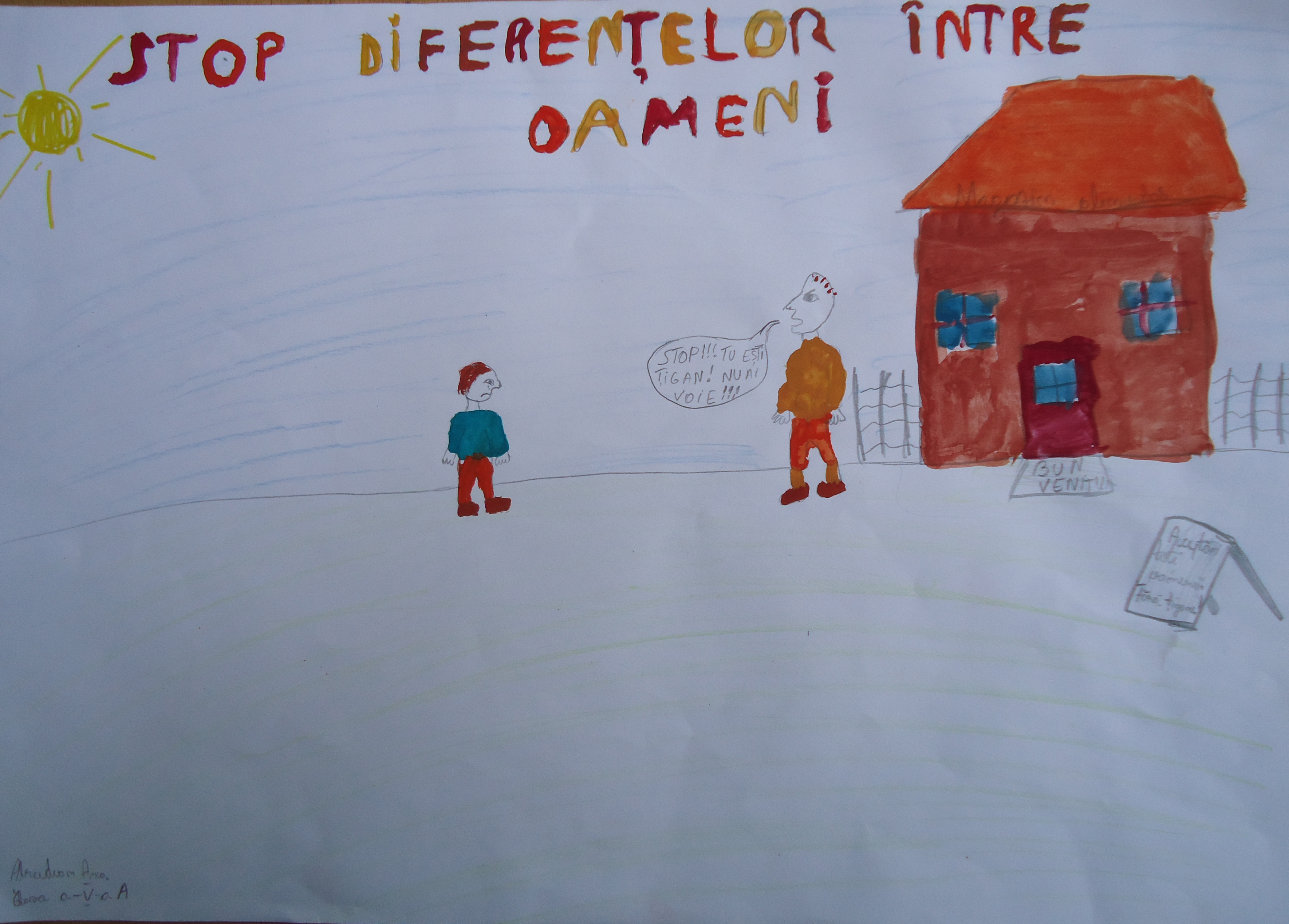
“Stop! You’re a Gypsy! You’re not allowed.” Ana Abrudean, 5th grade student, during the workshop Școala Activistă, Cluj, 2012.
The radical change which theater brings to marginal groups and communities pertains to the reformation of the relation between performance, viewers and performers. The performance becomes a cultural act of participant observation in the middle of the realities with which a group of people is confronted, one of its main stakes being on-site performance. This means being in the very center of the marginality which inspired the performance in the first place. The research creates a strong human bond between those who communicate a documented reality – the project team – and those who are interviewed and thus become implicit creators of the performance. The artists are the “community biographers” and their ethical involvement is extremely important, precisely because the performance does not exclusively reflect their needs of expression and legitimation. The essential transformation brought by participatory art, discussed by Claire Bishop in Artificial Hells. Participatory Art and the Politics of Spectatorship[1] – “the artist becomes a collaborator, a producer of situations, the audience being a co-producer, a participant in the artistic act” – problematizes the role of the viewer for whom the cultural act becomes part of everyday life. The performance is the link with what people recognize happens to them every day or the challenge to take part in what could happen to them. This repositioning of the viewer makes him/her be more actively involved in what he/she sees. The viewer is no longer a passive, docile witness to what has been prepared for him/her, but swiftly interferes in that world.
The participatory viewers are no longer subjected to the socio-cultural constraints which determine their conformist, decent behavior, and make them react to the theater as one conventionally does in a theater. On the contrary, this type of viewer watches himself and his peers act during the performance, not after it, genuinely living the enacted events. This gaze thus becomes a political act, a radical intervention into a type of social structure which the viewer needs to comment on because it is his/her world. The theatrical experience contains the data of the everyday experience of those for whom the performance is a double encounter. It is, on the one hand, an encounter with those daily issues which they can now regard with a more critical eye because the issues are presented in a more neutral setting (through the voices of other people). On the other hand, it is an encounter with their own role, both individual and collective, in an attempt to find a solution to those issues. We can, therefore, talk about a difference which I find significant: the one between the cultural viewer (who has learned the standard, ritualistic theater behavior), a viewer domesticated by inherited conventions, and the existential viewer (the one who lives what he/she sees in real time and acts accordingly). Disruptive viewers have the experience of life which is enacted before them and therefore, their direct intervention is an immediate reaction to what they see. Their gaze is a gaze of acknowledgement through participation in the reality which they are a part of. The viewers live what they see and spontaneously start a conversation with those before them, who are no longer actors in a performance, but ordinary people like themselves. The reality in the performance is, to them, the reality of their own existence. An inclusive reality, which fundamentally alters the relation of the people with the marginality they usually experience by adding surplus value to their legitimating stories. […] The viewer is no longer a passive individual, culturally immunized, observing a fictional reality with which he/she has no relation, but is the one who interferes and changes both the reality and those who are part of it.
The question that follows is: what kind of actor does this viewer need in order to have a conversation and how non-self-centered must the performance become in order to encapsulate the existence of the people interfering in its dynamics? The actor, in this instance, is no longer a creator of neutral fiction, but an activist actor, one who communicates the political biographies of those he/she has researched. The researcher-actor must regulate his presence on stage in agreement with what is going on off-stage. The actor replies immediately to the person who regards him/her as someone with whom he/she is sharing a life experience. The actor becomes the neighbor from across the street in a type of theater which creates empathetic neighborhoods. For the participant viewer, the stage becomes the place where he/she lives. […]
Interaction with the disruptive viewer and his/her anarchic gaze is an opportunity for the theater to redefine its functionality, its necessity and its connection with worlds which are excluded from the space of artistic representations. The disruptive viewer is an opportunity for the theater to exhaust its recycled conventions and invent itself from the interaction with those communities which spawned it in the first place. The disruptive viewer is the viewer who removes the identifiers of the theater and hurls it into the everyday life of the marginalized.
[1] Claire Bishop, Artificial Hells. Participatory Art and the Politics of Spectatorship, London, Verso, 2012.