


by Radu Apostol
The process of education by means of Educational Theater is an extension of the way education is conducted within the household. A classroom during a class of educational theater strongly resembles the floor in “the children’s room”; in fact, it resembles the floor in any room where there are children. There are no predetermined “better seats” or “worse seats”, there are no insecurities induced by “the front desk” or “the back desk”, because encounters leading to a performance scene can occur anywhere within this space, anywhere the imagination of the participants takes them. There is no teacher’s desk, and therefore no single direction to channel a dominant interest, no “position of force” as the only depository of knowledge and information relevant for the student. There is no relation of dominance between the teacher and the student, as the classroom architecture in the traditional education system often induces.
The role of the teacher in Educational Theater is similar to that of the parent, the grandfather, the older sister/brother or friends. The teacher represents first and foremost a reference of security and safety for the student, not one of authority; he/she represents a partner in playtime.
The most painful break occurring in a child’s universe upon leaving “the home” and entering “the classroom” is the one in the relation between the surrounding reality and his/her imagination. All of a sudden, the chair ceases to be anything else and becomes a mere piece of furniture which you MUSTN’T smash, you MUSTN’T drag around, but simply sit on, obediently, waiting for the lesson to begin; toys have to be confined to the home and you find yourself surrounded exclusively by objects whose utility you do not understand. Education by means of Educational Theater is an extension of the “seven years at home”. The child develops through playtime. The fundamental values become spontaneity, creativity and team spirit. There are no prizes, no laurels, no degrees, no grades. The only competition is with yourself.
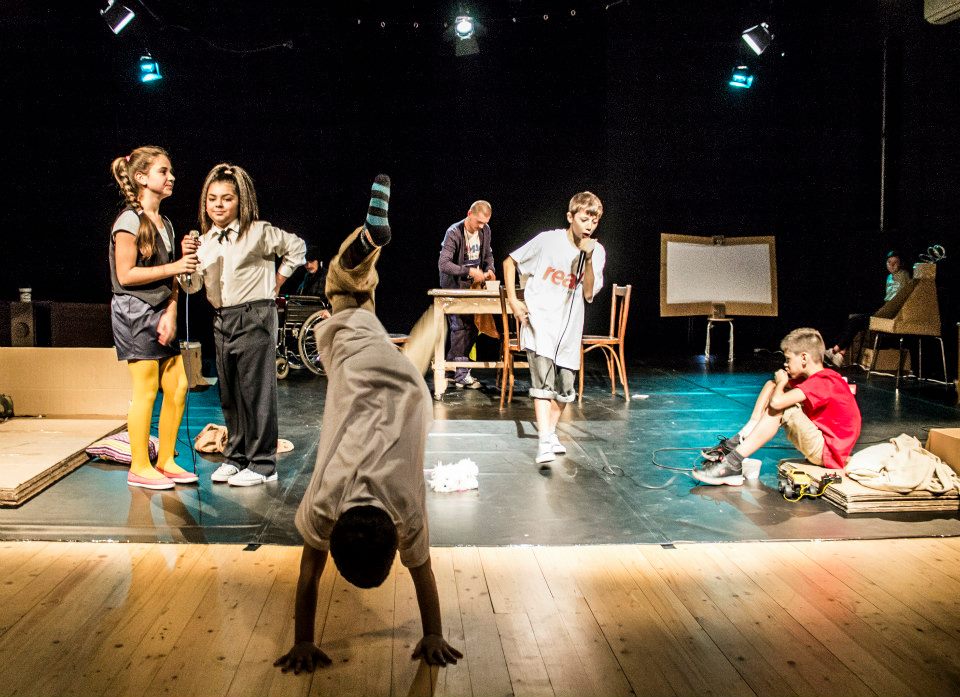
Familia Offline, 2013. Written by: Mihaela Michailov, directed by: Radu Apostol. Photo: Ioana Raluca.
The selection process in Educational Theater
Every weekend, for almost a year, we (the team behind the performance Familia Offline, including children, actors, playwright, scenographer, musician and director) managed to develop educational theater workshops. The participants were children from School no. 55 in Republica neighborhood in Bucharest. The only selection criteria were attendance and participation. The children who came on a regular basis and took part in the theatrical games gradually made up the team of educational theater.
We believe it is very important that the selection be determined solely by the participant’s choice and his/her ability and availability to get involved in the theatrical games and exercises. If not, each child’s creative and spontaneous contribution will be infected by a series of prejudices determined by “selection criteria”. The child will not behave spontaneously and creatively, but will strictly reproduce standardized patterns of success, because his/her only stake is being like the one who is number 1. Educational Theater is not a platform for talented children, but a medium of education and development for any child by means of theatrical games which challenge the children to express themselves creatively, spontaneously and artistically.
[…]
A very important stimulus for the entire group is the moment when the teacher-pedagogue-artist makes “a mistake”, when he/she “loses” a theatrical game. Just like in lateral thinking, in Educational Theater “a mistake” is an essential factor for education and development, a stimulus of creativity. Most children do not take part in activities and games for fear of “making mistakes”, and that’s because the traditional education system incriminates mistakes.