


by Mihaela Michailov
Janusz Korczak revolutionized 20th century pedagogy by laying the emphasis on personalized education – understanding the subjectivity of every child, who thus became the social creator of a world he/she had to be allowed to experience; without being judged, without having their tiniest of mistakes scrutinized, without having their opinions minimized, without being asked to “play nice” for the amusement of those around. The child is not a small, playful entertainer who does a balancing act on the high-wire of adult demands in order to satisfy the competitive ego of the latter. The child is not a game for grown-ups. Janusz Korczak restructured the orphanage system in Poland at the turn of the 20th century and constantly militated for a pedagogy of respect for children’s rights, a pedagogy of partnership in creation which was meant to find a common ground for participation wherein both teacher and student could develop together in the spirit of emotional freedom, of a lucid exchange of needs and ideas and of the desire to represent him/herself. According to Korczak, nothing estranges the child more than the feeling he/she has to be something they are not, that they have to adapt to a world in which they mostly do not count for anything, that they have to become meek, trained, stiff. That every single day they have to postpone the joy of inventing new territories of anarchy.
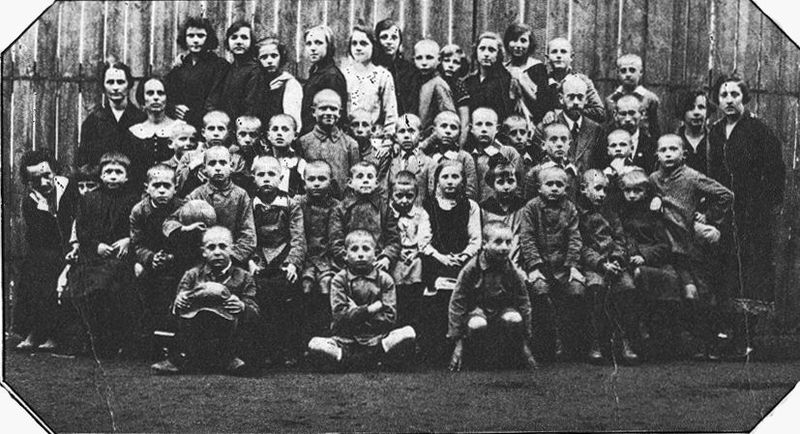
Korczak and the children in the 1920s. Source: en.wikipedia.org
Against a Pedagogy of Prohibition
Janusz Korczak (the pseudonym of Henryk Goldszmit) was a pediatrician, pedagogue, teacher, author of children’s books and social activist. In 1912, he established an orphanage for Jewish children which was run on several political principles of self-government. The children formed a micro-society which functioned according to rules they themselves put into practice, thus constructing a political model for a democratic participatory community. In 1919, Korczak set up “Our House” for the Polish children of Pruszkow – a common space for reflection and action, regulated by the interventions of the children- pedagogues. During 1926-1939, Korczak published Mały Przegląd (The Little Review), which hosted materials written by children, documenting their everyday life, the transformations of the education system they had proposed and the projects they got involved in. In August 1942, the employees of the orphanage and all the children were deported to the extermination camp at Treblinka and Korczak chose to leave with them, refusing an American passport. His march to the death trains alongside the 200 children represents a manifesto of solidarity and collective resistance against the denial of the right to life and of the right to a decent childhood, for which Korczak struggled his whole life.
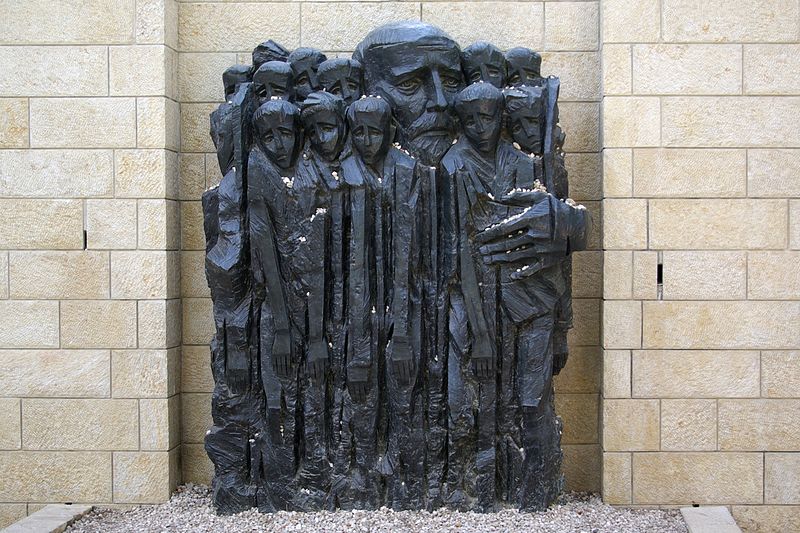
„Janusz Korczak and the children ”, memorial at Yad Vashem. Source: en.wikipedia.org
[…]
The Child-Pedagogue
To Korczak, the child was the pedagogue who taught himself and those around to take the necessary time to get to know oneself. To live free and well aware of the changes he/she can bring about. To succeed, with every new experience, in representing him/herself and those alongside whom he/she grows up. Janusz Korczak never minimized the children’s sphere of knowledge and action, their rebellions, their whims, the brutal or innocent way they related to everything around them, their apparently meaningless actions, their everyday triumphs and emotional catastrophes, the moments when they felt alone or happy. To Korczak, the child was never a tiny little man who doesn’t understand what’s happening to him/her because he/she is small and helpless: “There is no such thing as ‘children’, there are only humans – with a completely different scale of values, a different set of experiences, different impulses and another level of emotions. And remember we have no idea who they are.” Korczak militated for a team education in which the educator and the educated create a flexible community together, a community based on trust and on everyone’s right to be who they are and stand up for themselves. He was against a prohibitive, passive pedagogy, which turned the child into a storage unit for information which had little to do with his own life: “It is not through despotic rule, imposed rigor or distrustful control, but by means of tactful understanding, belief in experience, cooperation and cohabitation.” All these principles are the bedrock of a pedagogy of participatory reciprocity in which the given social roles – teacher-student – entail a permanent exchange of experiences and knowledge.
[…]
The newspaper plays an important role in organizing the children’s community, becoming an archive of everyday existence. The newspaper is a platform for children’s representation where everyone makes known their desires, their plans for the future, their worries, their failures, their attempts at changing something: “The newspaper is a strong link. It connects one week to the next, it brings together the children, the educators and the service staff in one invisible whole. The newspaper is read by all the children. For any changes, improvements, reforms, for any hardships and any complaints, the newspaper is the place where anyone can express them.”
Janusz Korczak wrote the history of 20th century pedagogy from the perspective of the community of reciprocal education. School is not about the teachers, about their need to command, about their frustrations and their attempts to turn the children into mechanisms easy to manipulate. To Korczak, school means generosity and respect. Respect for children’s mistakes, for their time, for their fears and insecurities. Respect for them, “the princes of feeling, poets and thinkers”.
1 comment
Un spectacol realizat dupa “Kajtus, vrajitorul”, cel mai popular roman al lui Janusz Korczak, puteti vedea pe scena mare a Teatrului Luceafarul din Iasi, o coproductie a institutiei iesene cu Institutul Cartii Varsovia si Institutul Polonez Bucuresti.
https://www.youtube.com/watch?v=WBNt5ygfMgc