


by Mihaela Michailov
On September 15 1958, “Fani Tardini” Theatre in Galaţi hosted the premiere of The Barefoot Bride, a play directed by Valeriu Moisescu. The text of the play – written by Sütő András in 1950 – centers on the Soviet-inspired collectivization process which took place in Romania between 1949 and 1962, a process which entailed the agglutination of farmland into collective farms.
The Barefoot Bride was staged nine times at the theatre in Galaţi and once in Bucharest during the Decade of the Theatre, after which it was cut. Valeriu Moisescu’s performance included Gheorghiu-Dej’s speech in which he announced the end of the collectivization process in certain parts of the country. The speech came after peasants in Vrancea County rebelled against collectivization. During these rebellions, several peasants were killed and many others were detained and deprived of their possessions. The Barefoot Bride premiered one year after the reprisal of the peasants’ rebellions.
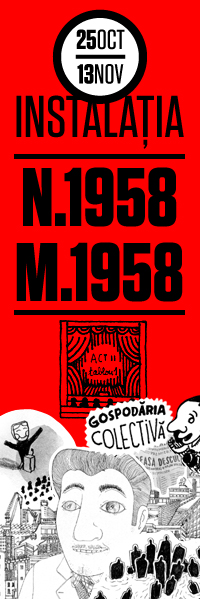 In 2012, directors Alexandru Berceanu and Ioana Păun designed an art installation based on the story of this cancelled performance. In 1958-1958. Submerging and Subversive Installation, the visitors receive guidance manuals for the materials that are neatly arranged on a table, they sign a minute and they read a comic strip which they can modify and become censors themselves. The installation questions the meaningless language of written reports, both then and now.
“The Storm by Ostrovski and The Barefoot Bride caused such a buzz that theatre reviewers barely had enough space to manifest themselves in the press for the next couple of years. Labels such as “excessive theatricality”, “gratuitous virtuosity”, “Piscatorian agitation theatre” or “formalism” went parallel with sometimes exaggerated words of praise to create a long-lasting impression of me as a “tabloid director.” A critic would later call me a test-pilot and I have to say it flattered me.” (Valeriu Moisescu, Persistența memoriei [The Persistence of Memory], Fundația Culturală Camil Petrescu, Revista Teatrul Azi, București, 2007, p. 29)
The Barefoot Bride by Sütő András (Fragments)
[…] The mother: I thought you signed up for the collective, too.
Cociş: I did, I filled in the form, but you know how people are. I left home, but sat for a bit in front of the church. Lit a cigarette. And then I started thinking about things.
The mother: I’ve been losing a lot of sleep over this, too, Mihai. But after I joined, I calmed down. What was on your mind?
Cociş: Pretty much everything. I thought about what happened, about the way things are, about the way they might turn out… I left home determined to stop this fretting. To join the collective! Whatever happens. I felt embarrassed to keep worrying about it. I’ve been losing sleep over it for the past two months. So I started thinking, 12 acres of land, 2 good oxen, a new cart, a harrow… it’s not peanuts. It didn’t fall out of the sky. I earned it with these two hands of mine.
The mother: People work so hard.
Cociş: If only they’d understand. If they walked in my shoes for just one day. If they knew how me an Cati saved for all this… we starved, walked around in shabby clothes. The bank owned us…
The mother: Come on, Mihai, join the collective.