


by Ana-Maria Murg
Underground. The Jiu Valley after 1989
By: Mihaela Michailov and David Schwartz
Cast: Alice Monica Marinescu, Katia Pascariu, Alexandru Potocean, Andrei Șerban
Scenography: Adrian Cristea
Music: Bobo Burlăcianu
Video and Photo Documentation: Vlad Petri
Theater Underground. The Jiu Valley after 1989 is a project of observation and analysis of the everyday life of those communities decisively affected by the social and political changes which began in the early 1990s. The project aims to document the economic situation, life and work of the miners during post-Socialism. Theater Underground is a project of performative reconstruction of the document-stories which set the foundation for the history of the communities in the Jiu Valley, communities which find themselves somewhere between survival, migration, disappearance and possible reconstruction.
The performance Underground is based on research done in the Jiu Valley and coordinated by Mihaela Michailov (playwright), Vlad Petri (photographer) and David Schwartz (director). The research was manifold: workshops, open discussions and interviews with miners, miners’ wives, pensioners, children, security guards at the mine, union leaders and people who make a living out of stealing coal. Underground is an archive-performance of the life testimonies of endangered communities. The performance aims to revalue the stories, the issues and the culture of those social categories often ignored in post-Socialist Romanian theater: working-class communities.
The Jiu Valley as a region and a collective entity has remained in the collective imaginary and the recent history of Romania. Only after I began living outside it did it become obvious to me that the names of the specific cities which make it up are less familiar. But the phrase “Jiu Valley” transmits familiarity; not so much a spatial one as one of historical temporality marked by change. A sort of cliché symbol for the regime change of 1989-90 and a touchstone in reverse for the progress made by Romania after socialism: the more derelict the area becomes, the more progress is made towards overcoming the (post)socialist condition. The people living in the region have gradually (some quite rapidly) become a dislocated, marginal group both symbolically and in terms of their usefulness for contemporary capital. In the mainstream media, we/they are mostly depicted as out of touch with current realities.
This situation is partly reproduced even in smaller, allegedly more progressive, circles. As my interest for the Jiu Valley communities gradually became one of research, as well, I actively sought out academic, journalistic or documentary initiative where I could find at least a part of the reality I knew. Projects interested in more than just the static stereotype of the miner and of the “mining” community or in the folklore of the momârlani (the original inhabitants of the Valley, living mostly in rural areas) are harder to find. Theater Underground – The Jiu Valley after 1989 is a lovely exception, which caught my eye with its option to focus precisely on the volatile daily realities of the region. The project team chose to uncover realities rather than extract them, to learn about things together with the people who share their stories about the local social constellation. The resulting performance is a view into a world filled with diverse characters, whose stories construct a complex image of living communities, continuously engaged in creative – and most often difficult – ways of surviving.
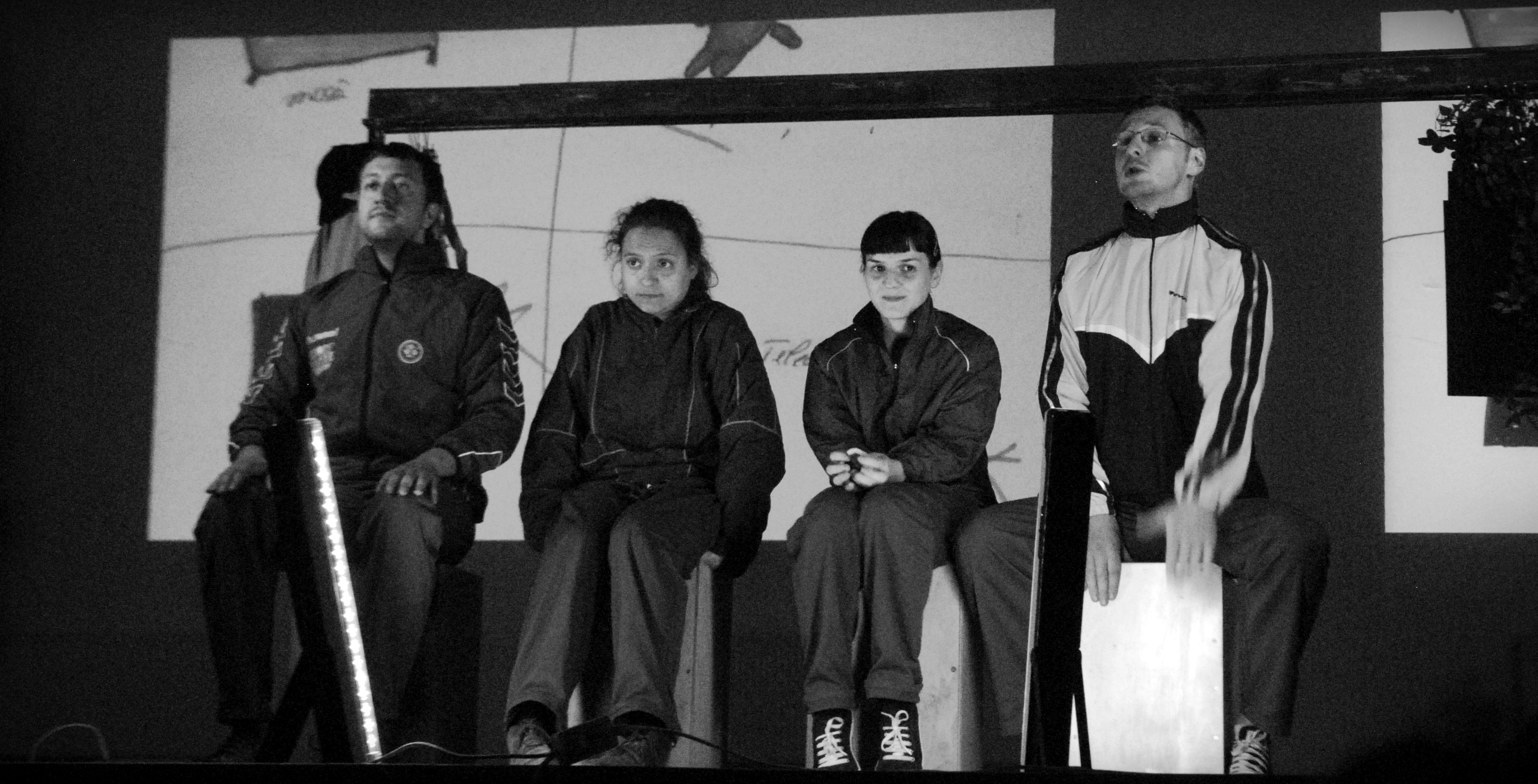
UnderGround, 2013. Photo: Ioana Szilagy
As a process, performing the memories and experiences of people in the region before a live audience works in two directions. For those involved in the project, who share personal developments, and for those in the Valley, who listen to them, the staging of narrations about the past and the present reaffirms common points, draws and redraws connections of a common history, of belonging to a group. At the same time, it is a reminder and a reliving of certain events at an individual level, as well as at the group level.
For those who have a chance to watch the collages made up, on the one hand, of historical moments already entered in “official” history, such as strikes, mining accidents, “mineriade” (coal miners storming Bucharest in the nineties), layoffs, and on the other hand private moments, bits of everyday life and a wide range of emotions, the performance contributes to an understanding of the complexity of recent history in the Jiu Valley. Performing the inhabitants’ narratives using the actors’ bodies, the words of the people, movement, gestures and a minimal decorum charges the stories emotionally. The affective vibrations embedded in the stories make them more powerful, more memorable and therefore more resistant to erasure from memory.
The need for a structure to coagulate all the stories meaningfully poses obvious problems, but framing them as part of a museum is somewhat questionable. The life of the locals has no doubt been shaped by the evolution of mining, and the pit closures have disrupted forms of sociability and practices which supported ways of life and connected people. The transformations which followed meant very often vulnerability and degradation: of the socio-economic structure, of the political relevance of the communities, of the workers’ status, of the locals’ bodies, of the environment. The museum framework for “endangered communities” fits with the empty discourse of the authorities, which promote “saving” the region through culture and tourism, and also contributes to the strengthening of the dominant historiography which tends to reduce the realities in the Jiu Valley to a single relevant dimension: mining during and after socialism. […]
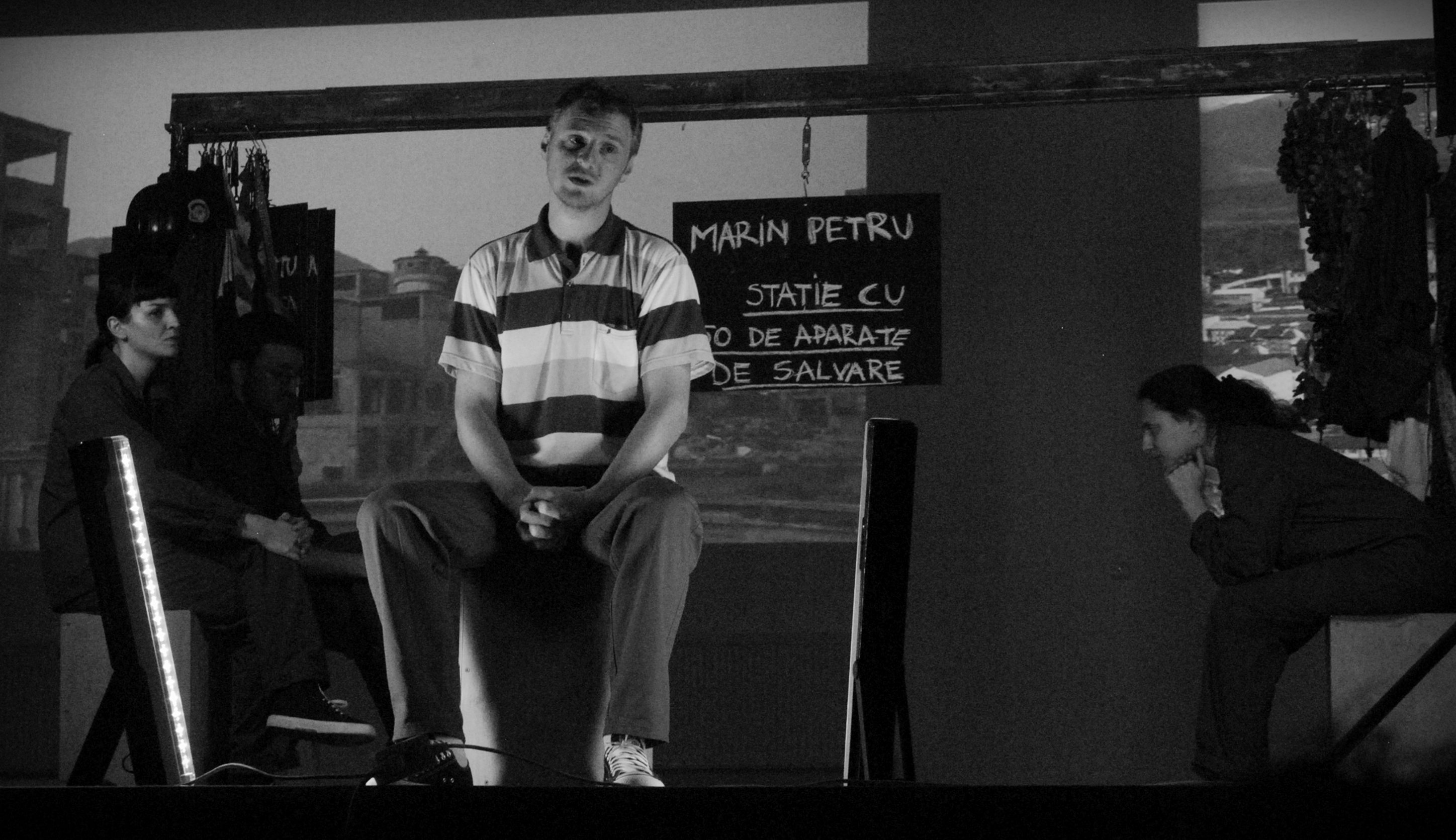
UnderGround, 2013. Photo: Ioana Szilagy